How to Soundproof an Apartment Without Drilling
Use removable, freestanding and soft-surface changes to make an apartment feel quieter without putting holes in walls—while knowing which kinds of noise these renter-friendly methods can and cannot meaningfully improve.
- Renter-conscious
- Surface-safe guidance
- Deposit-minded
To soundproof an apartment without drilling, start by reducing hard-surface reflections with rugs, curtains and upholstered furnishings; then improve room layout, place freestanding mass such as a full bookcase near the problem wall, and address obvious door or window gaps only with removable methods that your lease permits. These steps can make a room less echoey and can soften some everyday noise, but they will not recreate the isolation of a purpose-built wall, sealed assembly or structural floor treatment.

Soundproof Apartment Without Drilling: What Actually Works
In renter conversations, “soundproofing” often means two different things. The first is making the room itself calmer by reducing reflections and echo. The second is stopping a neighbor’s television, voices, footsteps or bass from passing through the building. Those are not the same job.
Porous materials such as textiles can absorb sound that would otherwise reflect from hard surfaces. That is why a sparsely furnished room with bare flooring often feels sharper and more echoey than the same room with a rug, curtains, upholstery and books. The U.S. National Institute for Occupational Safety and Health also distinguishes absorption from barriers and enclosures: absorption helps reduce reflected sound, while blocking transmission depends more on the construction and continuity of the barrier.
For a renter, that distinction matters. A no-drill setup can improve the acoustic character of your room and may reduce some noise at the edges. It usually cannot change the wall assembly, floor/ceiling system or flanking paths hidden inside the building. Treat the goal as meaningful improvement without permanent alteration, not a promise of silence.

Choose absorption when…
Your room is echoey, voices sound harsh, or hard floors and bare walls make everyday noise feel louder inside the room.
Choose layout changes when…
Your bed, desk or sofa sits directly against the noisy shared wall and you can create more distance without creating a circulation problem.
Use another strategy when…
The problem is strong bass, ceiling footfall, plumbing vibration or a building-wide issue. Those can travel through structure and may need landlord or professional involvement.
Identify where the noise is entering
Spending money before you know the path of the noise is the fastest way to end up with a room full of “acoustic” products that solve the wrong problem. Spend a few quiet minutes identifying when and where the sound is strongest.
Airborne noise
Conversation, television and some street noise travel through air and can arrive through walls, doors, windows and gaps. A closed door that leaks sound around its perimeter may deserve attention before you cover an entire wall with decorative panels.
Impact or structure-borne noise
Footsteps, dropped objects, furniture movement and bass can excite the building structure. A rug in your unit may help with sound you create on your own floor, but it cannot guarantee relief from impact noise originating in the unit above.
Six ways to make an apartment quieter without drilling
Start with the floor
Large hard surfaces reflect sound, so the floor is an efficient place to begin. Use an appropriately sized area rug in the zone where you sleep, work or talk. A separate rug pad can add softness and reduce movement of the rug. In an upstairs apartment, rugs can also be a considerate way to soften the noise your own footsteps and movable furniture create.
Do not expect a rug to block strong neighbor noise through a wall or ceiling. Its main renter-friendly value is reducing hard-surface reflection and softening activity on your side of the floor.
Use substantial curtains at windows
Fabric adds absorption to a reflective window area. Full-length curtains with generous coverage can make a room feel acoustically softer, especially where glass dominates one wall. If your lease allows a tension rod or an existing curtain track can support the treatment, you can do this without drilling new holes.
Heavier fabric is not a substitute for a purpose-built high-performance window. If traffic noise is entering through glazing or frame gaps, curtains may make the room feel less bright acoustically without eliminating the underlying transmission path.
Move your listening or sleeping position
If your bed headboard or desk is pushed directly against a noisy party wall, experiment with moving it to an interior wall or creating a little separation. Moving the receiver is a legitimate noise-control principle: you are changing the geometry instead of altering the building.
This is often free, reversible and worth trying before you purchase wall treatments. Keep furniture clear of required ventilation, radiators, heaters and safe exit paths.
Place freestanding furniture near the problem wall
A full bookcase, wardrobe or upholstered piece can add a combination of mass, irregularity and soft contents in front of an otherwise bare wall. Keep the setup freestanding and stable; do not create a tipping hazard just to chase better acoustics. Where anti-tip anchoring is required for safety, follow the furniture manufacturer’s instructions and your lease rather than improvising a no-drill workaround.
Books and furniture are not a structural soundproof wall. Think of this as a practical room-layout improvement that can reduce exposed reflective area and sometimes make a shared wall feel less acoustically “live.”
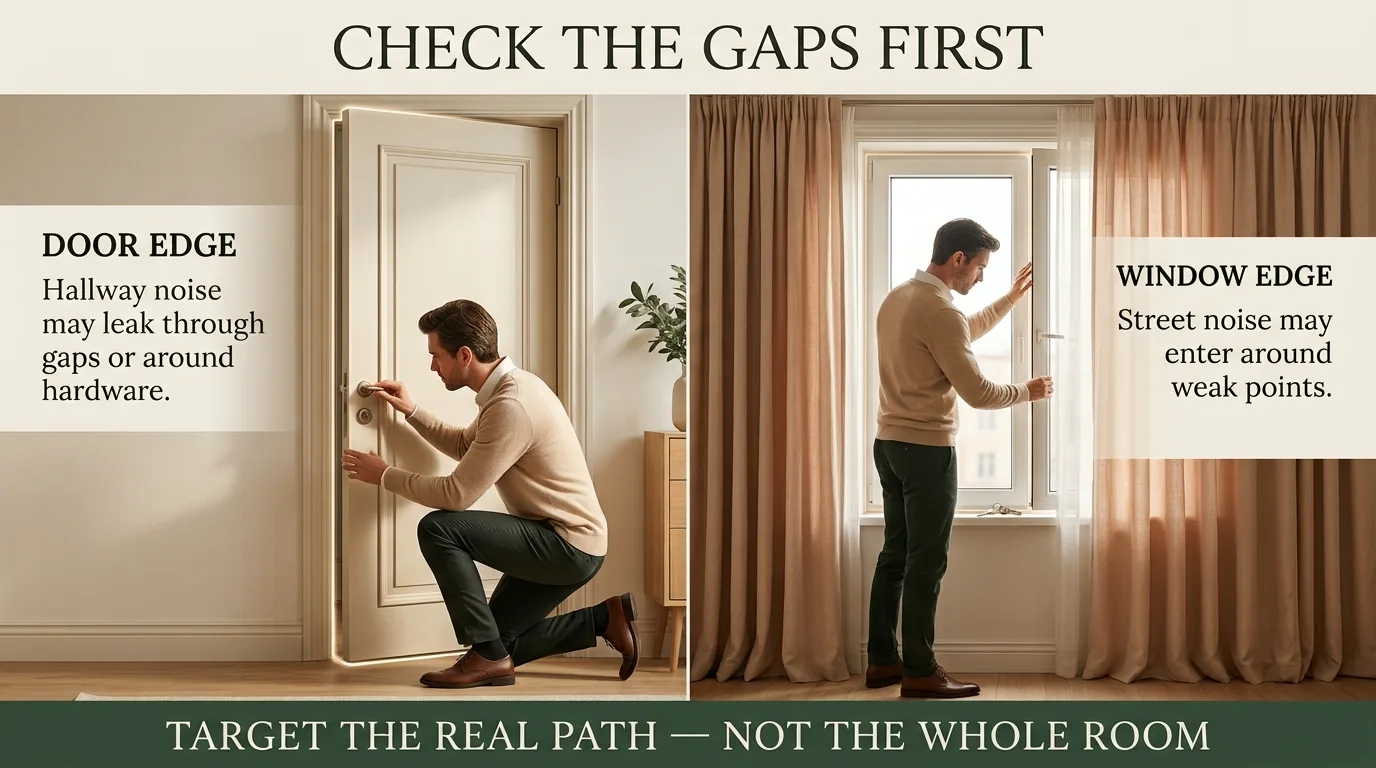
Check door and window edges carefully
Sound can use openings that also pass air. If a hallway door has an obvious under-door gap, a removable fabric draft stopper may be a low-commitment experiment. For adhesive weatherstripping or other attached seals, first confirm that the lease permits it and that the exact material is compatible with the painted, stained, vinyl or metal surface you have.
Do not block required airflow, fire-safety clearances, drainage paths, locks or egress. Never apply a permanent seal to a rental opening simply because it looks acoustically useful.
Add soft furnishings where they help the room
Upholstered seating, fabric headboards, cushions, throws and textile wall hangings can reduce the amount of exposed reflective surface. This is most useful when the room is currently sparse. It also fits naturally with a renter-friendly decor plan rather than making the apartment look like a temporary recording booth.
If you are considering mounted acoustic panels, do not assume “removable” adhesive is compatible with your paint. The safest renter-conscious route is to verify both the panel mounting instructions and the surface instructions before attaching anything. Our guide to hanging art without nails explains the same surface-first mindset.

Which no-drill sound-control method should you try first?
| Method | Most useful for | What it does not solve | Renter check |
|---|---|---|---|
| Large rug + rug pad | Hard-floor reflections; softening your own footfall/activity | Strong wall or ceiling transmission | Use a pad suitable for the actual flooring finish |
| Full-length curtains | Reducing reflective glass area; softening room acoustics | Replacing a high-performance window assembly | Use an existing rod/track or lease-permitted mounting method |
| Freestanding bookcase | Adding furniture and irregular mass near a bare shared wall | Creating a sealed sound-isolation wall | Prioritize furniture stability and anti-tip safety |
| Furniture relocation | Moving bed/desk away from the strongest noise zone | Changing the building construction | Keep exits, vents and heaters clear |
| Removable door draft stopper | Obvious under-door opening; hallway sound at floor level | Sound passing through the door slab or adjacent wall | Do not interfere with door operation or required clearances |
| Soft furnishings | Echo and harsh reflections in sparse rooms | Low-frequency structural vibration | Usually low surface risk because nothing is attached |
Doors and windows deserve a separate check
A shared wall gets most of the attention, but a hallway door or leaky window can be the more obvious path. Listen at the perimeter rather than assuming the entire surface is equally responsible. If sound becomes sharply clearer at one edge, prioritize a reversible intervention there before buying decorative panels for another wall.
Be conservative with attached seals. Paint chemistry, surface age, finish, temperature, moisture and removal technique can all affect how an adhesive behaves. “Removable” is not a universal promise for every rental surface. Test an inconspicuous area where the manufacturer permits testing, and stop if the surface shows lifting, softening or discoloration.
What should you try first for the noise you hear?
The most useful no-drill change depends on the sound path. Start with the option that matches the problem you can actually identify, then reassess before adding more products.
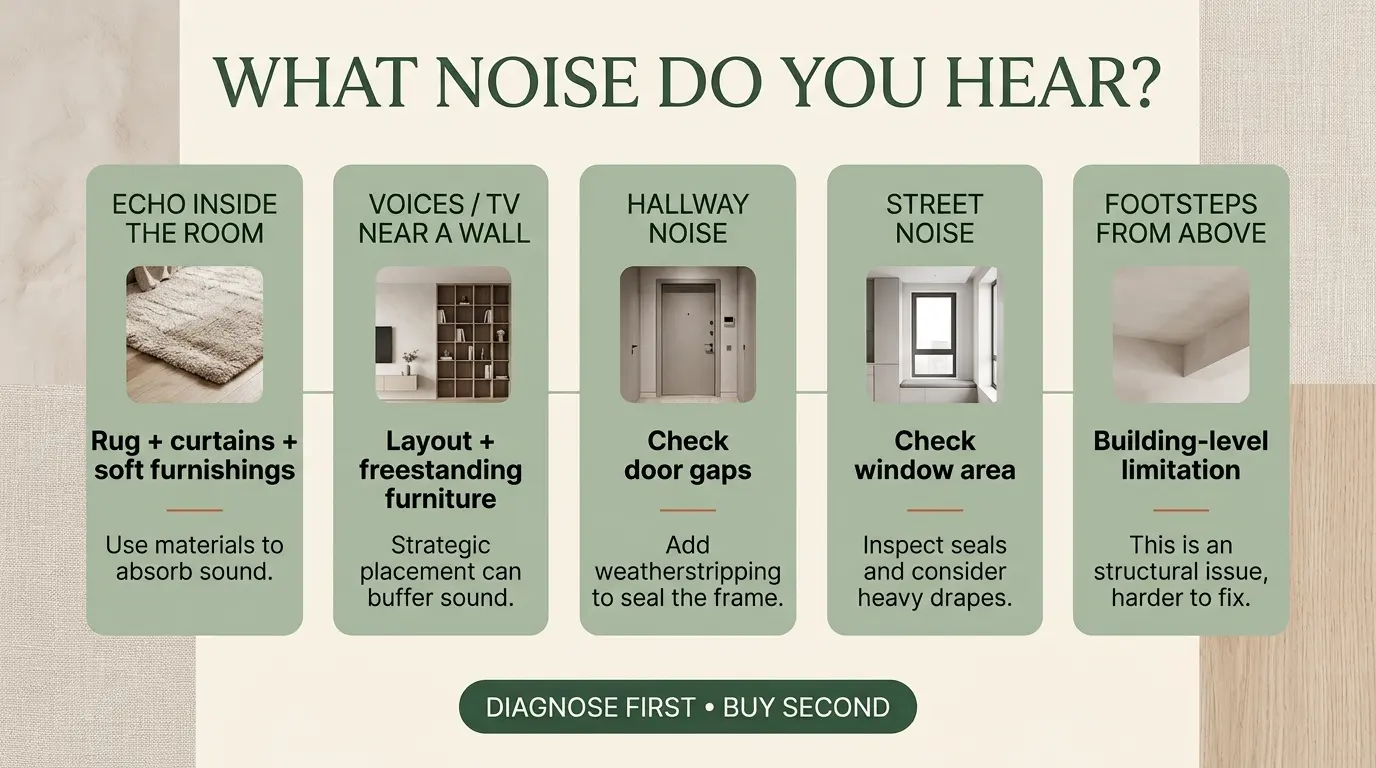
Echo inside the room
Start with a larger rug, curtains and soft furnishings to reduce exposed reflective surfaces.
Voices or TV near a shared wall
Try moving the bed, desk or sofa and using stable freestanding furniture near the problem wall.
Hallway or street noise
Inspect door or window edges first, then use only lease-permitted reversible methods that do not interfere with safety functions.
Footsteps or strong bass
Recognize the limitation of decor-level fixes. Structure-borne noise may need property-management or professional attention.
What to look for before buying acoustic products
Product pages can blur “sound absorption,” “noise reduction” and “soundproofing.” Before you buy anything, match the product’s stated function to your actual problem. A decorative porous panel may be useful for reflected sound inside the room; it should not be treated as proof that the wall will stop a neighbor’s bass.
For rugs and pads
- Choose enough coverage to soften the functional zone, not just a small accent rug.
- Confirm the rug pad is suitable for your exact flooring finish.
- Avoid rubber, latex or other backing claims you cannot verify for the floor you have.
For curtains
- Prioritize generous width and full-length coverage if your goal is to reduce exposed glass.
- Check whether your existing rod, track or tension system can safely support the curtain.
- Do not rely on a marketing label alone as evidence of structural sound isolation.
For acoustic panels
- Look for a clear explanation of whether the product absorbs reflected sound or is intended as part of a transmission-control assembly.
- Verify the exact mounting method and approved surfaces.
- Do not attach panels above a bed if the mounting method is not specifically appropriate for that use.
For door-gap products
- Prefer removable, non-attached options when they can solve the specific under-door issue.
- Check that the door still opens, closes and latches normally.
- Never obstruct required ventilation or emergency movement.
Common apartment soundproofing mistakes
Covering one wall with thin foam and expecting silence
Porous material can help with reflections, but stopping transmission is a different acoustic problem. A thin decorative layer is not equivalent to a dense, continuous, purpose-designed partition.
Using aggressive adhesive because drilling is forbidden
No holes does not automatically mean lower damage risk. An adhesive that pulls paint, paper facing or finish during removal can create a bigger repair than a small approved fastener would have.
Ignoring the lease because the change is “temporary”
Some properties restrict attachments, window treatments, weatherstripping or modifications to doors. Review the lease and ask management in writing when the rule is unclear.
Blocking noise with unstable furniture
Do not make a tall bookcase less safe just to keep it “no drill.” Follow the furniture manufacturer’s anti-tip and anchoring requirements. Safety outranks a no-hole decorating goal.
If you are building a wider renter-friendly room plan, also review our guide to deposit-costing decor mistakes. It covers the same principle: avoid trading a small design inconvenience for an expensive surface or move-out problem.
When no-drill solutions are unlikely to be enough
Persistent bass from an adjoining unit, repeated impact noise from above, loud plumbing vibration, or noise that is nearly unchanged as you move around the room can point to a building-path problem rather than a decoration problem. Low-frequency sound is particularly difficult to control with simple barriers and soft furnishings because it can travel through openings and structure in ways that are not obvious from inside your unit.
At that point, more pillows and foam may only add cost. Keep a dated log of the pattern if the problem is persistent, and use your property’s normal communication or maintenance process. The goal is not to accuse a neighbor or diagnose a building defect yourself; it is to document enough detail to explain when the problem occurs and why ordinary renter-level changes are not addressing it.
For small homes, layout improvements can still make daily life more comfortable. Our studio apartment decor ideas can help you rearrange zones without sacrificing circulation.
Plan removal before installation
The best time to think about move-out is before you stick anything to a wall, frame, floor or window. Keep packaging or installation instructions for any removable product you use. Photograph the surface before installation, especially if paint is already chipped, stained, soft or poorly bonded.
If you use freestanding methods—rugs, furniture placement, curtains on an existing approved system and textile decor—you reduce the number of surfaces that need adhesive removal later. For attached decor, follow the exact removal instructions rather than pulling quickly or improvising with solvents. Our no-damage wall decor ideas provides more low-commitment decorating options, and the first apartment decorating checklist is useful if you are setting up a rental from scratch.
Sources & Renter-Safety Note
The acoustic principles in this guide are grounded in National Institute for Occupational Safety and Health guidance explaining that hard surfaces reflect sound, porous textiles and foam can absorb reflected sound, and barriers/enclosures address a different part of noise control. NIOSH also notes that lower-frequency sound is harder to control with simple barriers.
CDC/NIOSH: Implement Engineering Controls for Noise
NoDamageDecor.com focuses on renter-conscious decorating, not professional acoustic engineering or legal advice. Building assemblies, leases and property rules vary. For severe or persistent noise, property management or a qualified acoustic professional may be more appropriate than adding more decor products.
FAQs about soundproofing an apartment without drilling
Can you really soundproof an apartment without drilling?
You can often make a rental noticeably less echoey and reduce some everyday noise with rugs, curtains, soft furnishings, furniture placement and careful gap control. True sound isolation usually depends on the wall, floor, ceiling, door and window assemblies, so no-drill decor changes should not be expected to recreate structural soundproofing.
Do acoustic foam panels stop neighbor noise?
Foam and other porous acoustic materials are mainly used to absorb reflected sound inside a space. They should not automatically be treated as a barrier that stops sound transmission through a shared wall. Check the exact product’s stated purpose and mounting instructions before using it in a rental.
Will heavy curtains soundproof an apartment window?
Substantial curtains can reduce the amount of exposed reflective glass and may make the room feel acoustically softer. They do not turn an ordinary window into a purpose-built sound-isolating assembly, especially where noise is entering through the glazing, frame or gaps.
Does putting a bookcase against a shared wall help?
A full freestanding bookcase can reduce exposed reflective wall area and add irregular mass and contents near the problem wall. It is a practical layout experiment, not a guaranteed soundproof barrier. Keep the furniture stable and follow any anti-tip requirements.
Can I use adhesive weatherstripping in a rental?
Only after checking the lease and the current manufacturer instructions for the exact weatherstripping and surface. Paint and finishes vary, and removable adhesive can still damage a weak or incompatible coating. Never block required ventilation, drainage, locks or egress.
What is the best first purchase for a noisy, echoey apartment?
If the room has large areas of hard flooring, a properly sized rug and floor-compatible rug pad are often a practical first step because they reduce exposed reflective surface without attaching anything to the walls. If the dominant problem is clearly a door or window gap, address that specific path first instead.
Renter-Safety Verdict
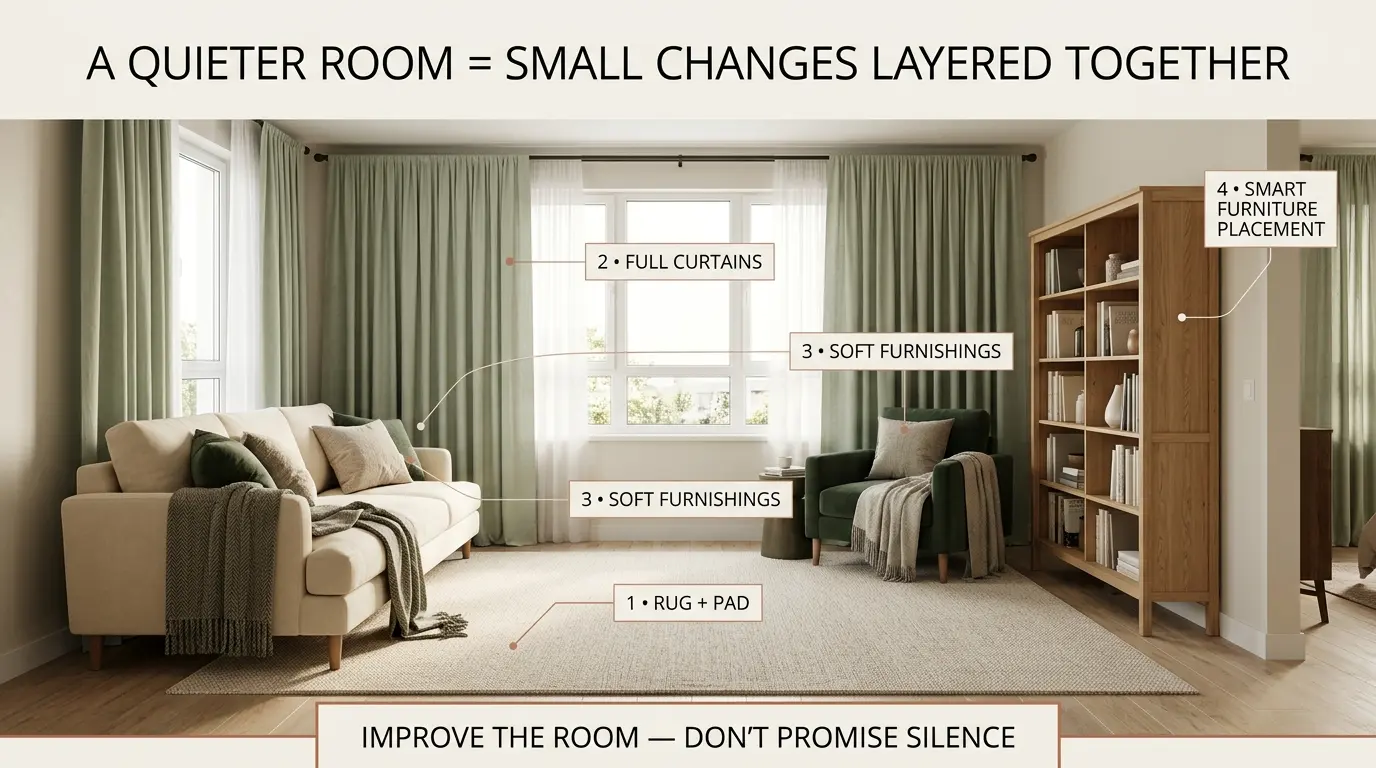
The strongest no-drill approach is a layered one: soften major hard surfaces, reposition the listening or sleeping area, use stable freestanding furniture strategically, and address only the gaps you can treat without interfering with building safety or violating the lease.
- Lowest surface risk: rugs, freestanding furniture and soft furnishings.
- Needs more caution: tension-mounted treatments, removable seals and adhesive-mounted panels.
- Do not improvise: heavy overhead panels, unstable tall furniture, blocked vents or permanent seals.
- Know the limit: structural vibration, heavy bass and impact noise may require building-level action.
Build the rest of the room with the same low-commitment mindset
Once the noise problem is calmer, use renter-friendly wall decor that does not force you into a repair project at move-out.
Explore No-Damage Wall Decor Ideas