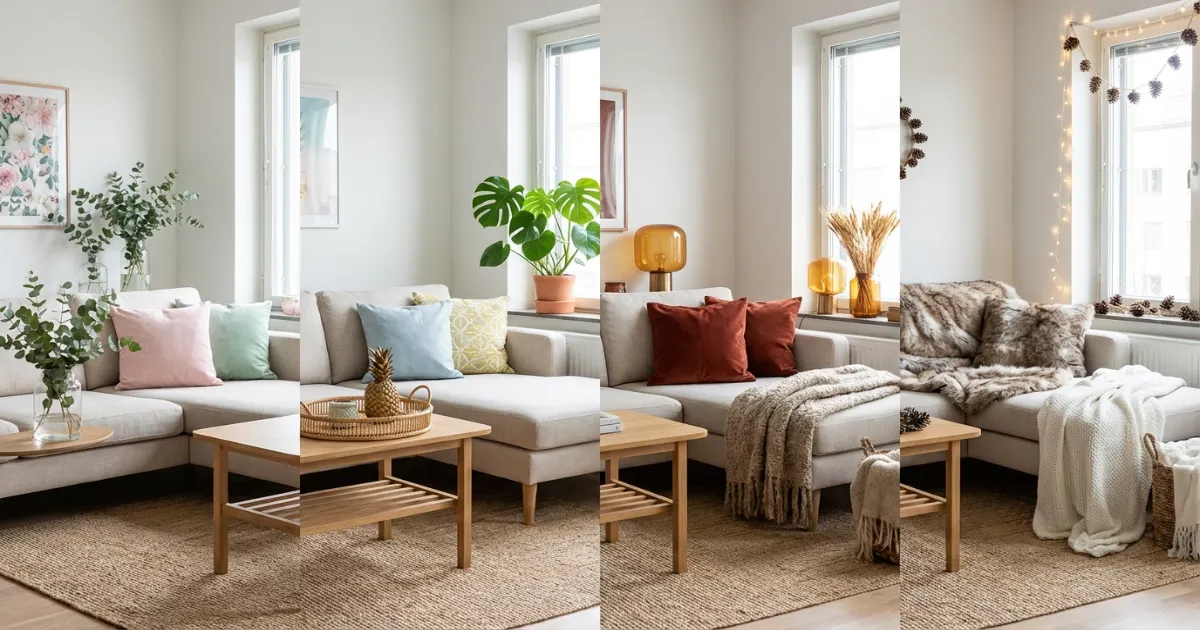

Your home should feel like it belongs to the current season — not stuck three months behind it. A simple seasonal decorating calendar is one of the easiest ways to keep your space feeling fresh, intentional, and alive all year long. And if you’re a renter or apartment dweller, the good news is you don’t need to drill a single hole or spend a fortune to make it happen.
This guide walks you through exactly when to swap your décor for each season, how early to start, how to store things in a small space, and how to make every transition feel effortless rather than overwhelming. Whether you’re decorating a studio apartment or a two-bedroom rental, this is your go-to seasonal home décor schedule for 2026.
Most decorators swap their home décor four times a year: early March for spring, late May or early June for summer, early September for fall, and mid-November for winter and the holiday season. A post-holiday reset in early January is also a smart fifth refresh. The best approach is to rotate textiles, greenery, lighting, and small accents — not everything at once — using renter-friendly, no-damage methods throughout.
Why a Seasonal Decorating Calendar Actually Helps
Most people redecorate reactively — scrambling to hang a wreath the week of a holiday or suddenly noticing their home still looks like December in the middle of February. A seasonal decorating calendar flips that script. It gives you a loose but intentional rhythm, so each transition feels planned, not panicked.
A structured approach also helps you avoid the twin traps of visual clutter (too many competing décor pieces fighting for attention) and décor fatigue (buying new things impulsively because something just feels off). When you know what’s coming next, you shop smarter, store better, and spend less.
For renters especially, having a clear system means you’re making the most of renter-friendly updates that come and go easily — no wall damage, no lost deposits, no stress at move-out. You’re building a flexible, rotating collection of accents rather than a permanent installation.
When to Swap Décor for Spring
Ideal window: Early to mid-March (or after the last major cold snap in your region).
Spring is the décor refresh most people crave and delay the longest. The goal is simple: lighter, brighter, and airier. Pull out anything that reads as heavy — dark throw blankets, chunky knit pillows, moody candles — and replace them with thinner textiles in soft greens, warm whites, blush tones, or buttery yellows.
What to Swap In
- Lightweight linen or cotton throw blankets in sage, ecru, or soft coral
- Fresh or faux botanical stems — eucalyptus, tulips, ranunculus, or simple greenery in a ceramic vase
- Lighter scented candles: clean linen, fresh citrus, or garden rose
- Pastel or floral table runners and cloth napkins
- Watercolor-style prints or botanical wall art — use adhesive wall art for a damage-free swap in minutes
What to Store
- Heavy faux-fur throws and flannel pillow covers
- Deep burgundy, charcoal, or forest green accents
- Any leftover holiday or winter décor still lingering in plain sight
If your kitchen feels dull after winter, a spring refresh there makes a big difference. Swap in lighter dish towels, a simple herb pot on the windowsill, or a new table centrepiece. Our full guide to spring kitchen décor has plenty of ideas if you need inspiration beyond the basics.
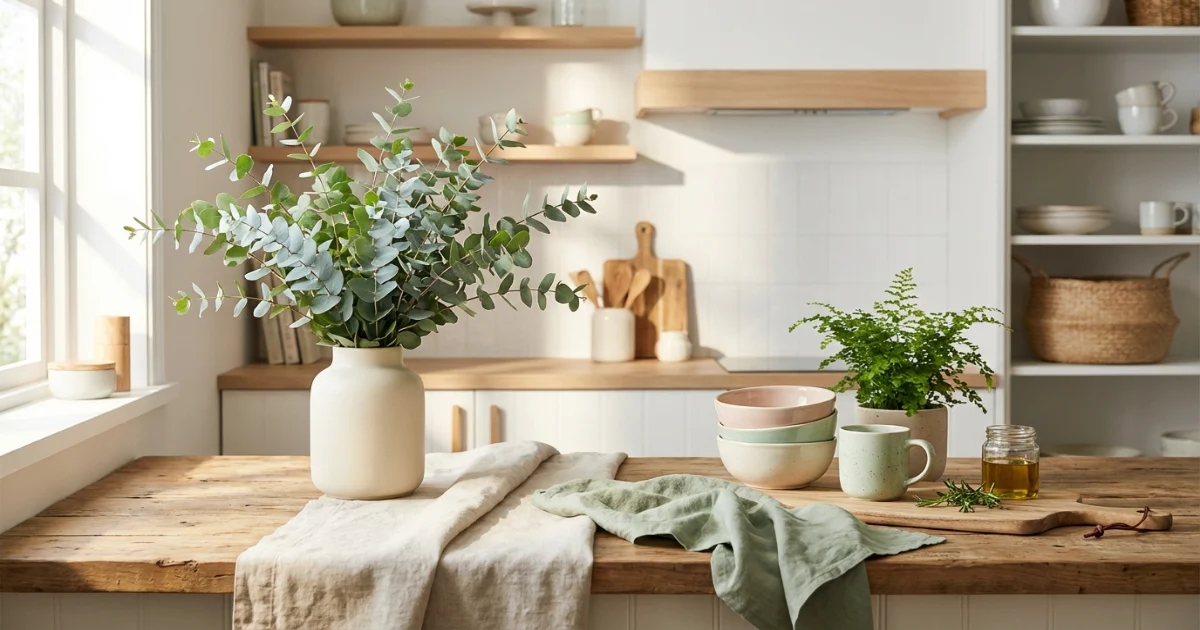
When to Swap Décor for Summer
Ideal window: Late May through the first week of June.
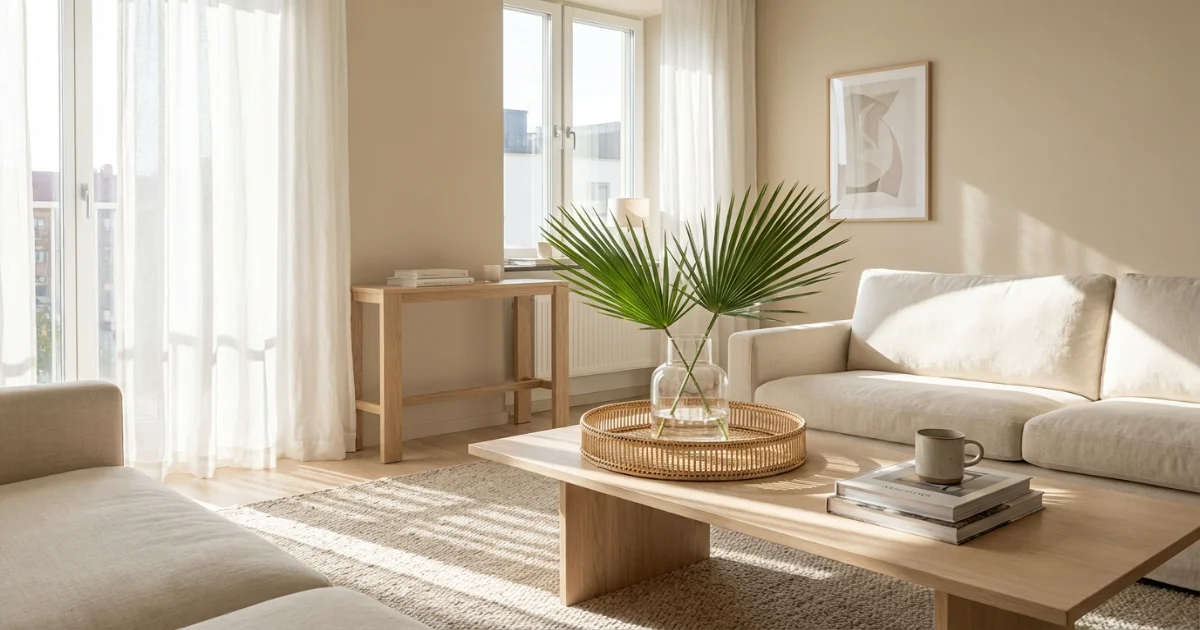
Summer decorating is less about adding things and more about editing down. The season calls for openness, natural light, and a breezy palette. If spring felt floral, summer should feel coastal, warm, or cleanly minimal depending on your personal style.
What to Swap In
- Woven rattan or bamboo baskets, trays, and accents
- Bright or warm-white throw pillow covers in cotton or linen
- Tall glass vases with dried pampas or tropical leaves
- Citrus, ocean, or warm sandalwood candle scents
- Lightweight sheer curtains if your current window treatments allow it
- Warm-toned or amber lighting — our guide to small apartment lighting ideas covers plug-in and battery-powered options that need no installation
Summer in a Small Space
Resist the urge to add more. Summer is the season to let your actual apartment breathe. Remove one piece of furniture-top décor for every new item you bring in. Swap a cluster of small items for one statement vase or sculptural object. Negative space is a design choice, not neglect.
When to Swap Décor for Fall
Ideal window: Early to mid-September.
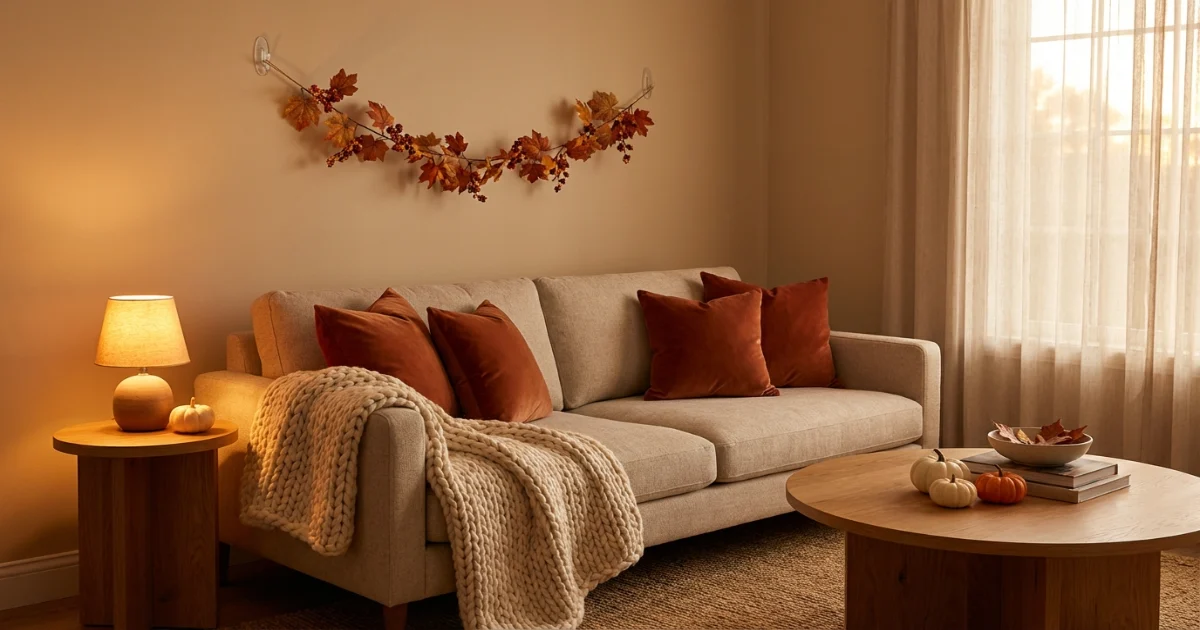
Fall is the décor season most people genuinely look forward to, and the temptation to start decorating in late August is real. Unless you’re in a noticeably cooler climate, resist until September — it keeps the season feeling fresh longer and prevents early burnout on pumpkins by mid-October.
What to Swap In
- Chunky knit throw blankets in rust, burnt orange, camel, or warm brown
- Velvet pillow covers in jewel tones: deep plum, forest green, terracotta
- Faux foliage in amber, red, and gold — a wreath on a damage-free hook is a classic and easy win
- Warm, spiced candle scents: cinnamon, clove, cedarwood, amber
- Wooden or ceramic pumpkins and gourds (which last the entire season)
- Warmer, amber-toned lighting to make your space feel cozy at dusk
Entryway Styling for Fall
The entryway is your first impression, and fall gives you so much to work with. A simple foliage garland draped over a shelf, a terracotta-toned doormat, or a compact vignette with a small lantern and a faux pumpkin can do more for the feel of a space than a full living room overhaul. Renters with limited entryway space can use a floating shelf (mounted with no-damage wall solutions) as a dedicated seasonal display spot.
When to Swap Décor for Winter and the Holidays
Ideal window: Mid-November through late November for holiday layering; early January for the post-holiday reset to simple winter décor.
Winter decorating happens in two phases for most people. The first is the holiday push — adding festive elements layered over your existing fall base. The second, often overlooked, is the quiet January edit: stripping out the explicitly holiday-specific pieces and transitioning into a calm, cozy winter aesthetic that carries you comfortably into February.
Holiday Phase (Mid-November to Late December)
- String lights, battery-powered candles, and LED wreaths — all renter-safe
- Removable window clings, fabric bunting, or a faux garland on Command strip hooks
- Seasonal throw pillow covers with subtle patterns (no need to buy new inserts)
- A simple tablecloth swap for a festive dinner-ready table
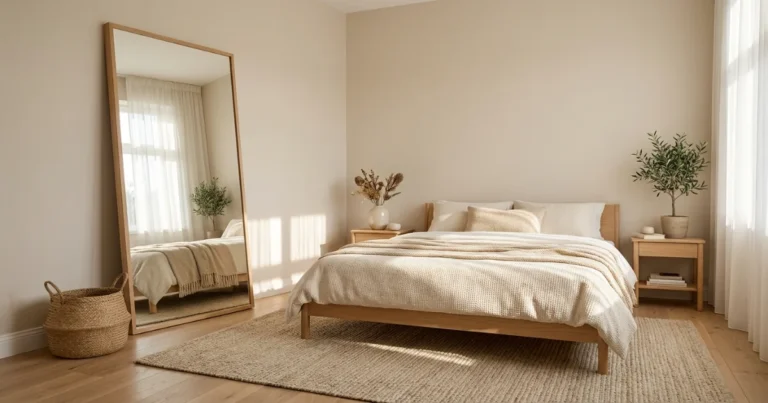
For wall décor, avoid nails entirely. Peel-and-stick décor and adhesive wall art let you rotate art seasonally without touching your walls. Some renters use a large leaner mirror or an easel-mounted print as a focal-point décor anchor that changes its surrounding vignette each season.
Post-Holiday Reset (Early January)
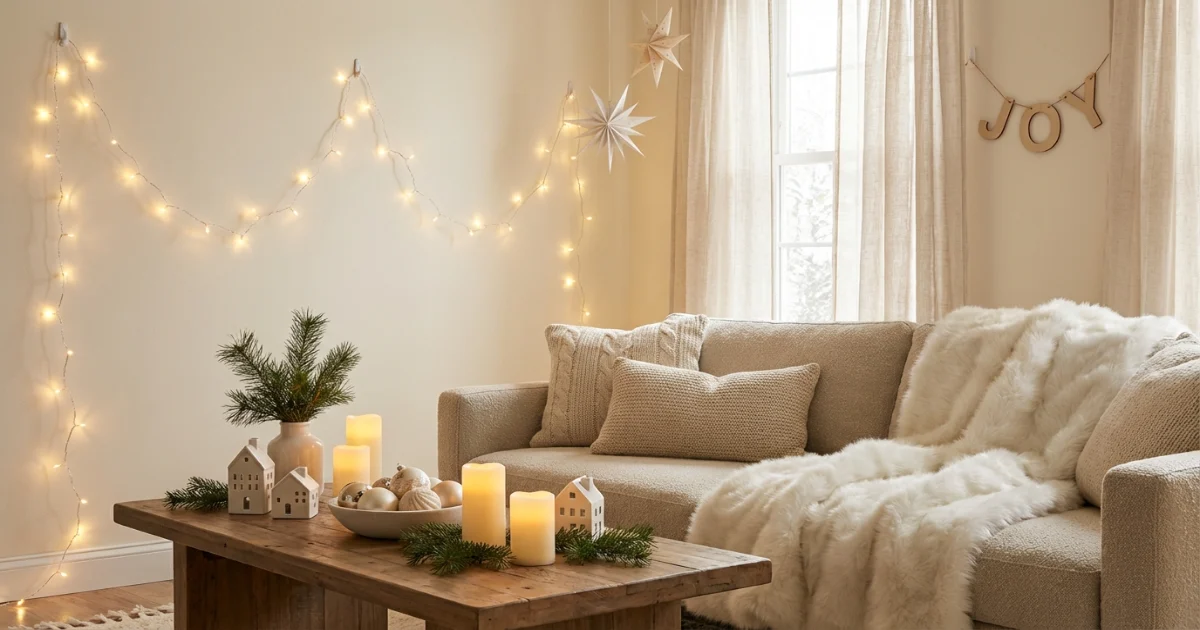
This is one of the most underrated seasonal transitions. After the holidays, strip back everything explicitly festive and replace it with clean, minimal winter styling: ivory candles, soft grey or white textiles, sculptural bare branches in a tall vase, and cool-toned prints or art. The goal is a restful, breathable January palette rather than a sad empty room.
What to Keep Out Year-Round vs. Rotate Seasonally
Not everything needs to go into storage four times a year. Knowing the difference between anchor pieces and rotating accents is what makes a seasonal decorating system sustainable rather than exhausting.
Keep Out Year-Round
- Neutral-toned area rugs in cream, grey, or warm tan
- Large mirrors — they work in every season and make small rooms feel bigger
- Woven baskets used as storage vessels
- Sculptural objects in natural materials: stone, wood, ceramic
- Core wall art in neutral palettes (save bold seasonal prints for rotation)
- Good-quality table and floor lamps (change the bulb warmth seasonally instead)
Rotate Seasonally
- Throw pillow covers and blankets (keep one set per season)
- Table runners, placemats, and decorative napkins
- Seasonal greenery: faux botanicals, wreaths, and florals
- Holiday-specific wall art and prints
- Candles and reed diffusers (scent is one of the fastest seasonal mood-changers)
- Small kitchen accents: canisters, tea towels, and countertop trays
How to Store Seasonal Décor in a Small Space
Storage is the biggest hurdle for apartment renters who want to decorate seasonally. The trick is to apply the same editing discipline to your décor storage that you apply to your actual space. Less is more, and multi-purpose is always better.
- Use flat, stackable bins that can slide under a bed or sofa. Clear lids mean you can identify contents instantly without digging.
- Vacuum-seal bags are excellent for bulky textiles — a whole season’s worth of throw blankets can compress to a fraction of their size.
- Label everything by season, not category. “Fall textiles” is more useful than “blankets” when you’re pulling boxes in September.
- Limit each season to one medium bin. If your spring décor doesn’t fit in one box, you have too much spring décor.
- Use the tops of closet shelves for lightweight items like faux botanical arrangements stored in garment bags to keep dust off.
- For small apartments with no storage, look into decorative trunks or ottomans that double as seasonal storage and occasional seating.
Best No-Damage Seasonal Decorating Ideas for Renters
If you’re renting, your decorating toolkit has one non-negotiable rule: nothing that can’t come down cleanly. The good news is that the range of truly excellent damage-free styling options in 2026 is broader than it’s ever been.
Wall-Safe Decorating
Command strips and similar adhesive hooks have become remarkably reliable for seasonal items like lightweight wreaths, framed prints, and hanging garlands. For anything heavier or more permanent-feeling, consider peel-and-stick wallpaper as a seasonal accent wall — perfect for a moody autumn bedroom or a fresh botanical spring living room. Read our full roundup of no-damage wall décor ideas for a complete guide.
Leaner and Shelf Styling
Instead of hanging art, lean large prints, mirrors, and framed artwork against walls, on floating shelves, or on picture ledges. This is one of the most popular renter-friendly styling methods because it looks intentionally editorial and requires no hardware. Rotate the art seasonally and your walls always look fresh without a single nail.
Textile-First Decorating
Textiles — throw blankets, pillow covers, table runners, curtains — are the fastest and most affordable seasonal update in any home. A single set of four pillow covers (two per end of a sofa) can shift a room from summer to fall in fifteen minutes flat. This is the seasonal swap most underestimated by decorating beginners.
Greenery and Natural Elements
High-quality faux botanicals have transformed seasonal decorating. A realistic eucalyptus stem, a well-made dried pampas arrangement, or a simple stem of artificial cherry blossom reads as genuinely seasonal without requiring water, light, or replacing every few weeks. Invest once in a few quality pieces per season and they’ll cycle back reliably for years.
Common Seasonal Decorating Mistakes to Avoid
- Decorating too early for the season. August Halloween displays and October Christmas trees feel rushed and make a home feel out of sync. Stick close to the seasonal windows suggested here.
- Not doing a post-holiday reset. Leaving holiday décor up through January is one of the most common reasons people feel unsettled in their own homes during winter. Strip it back.
- Buying too much each season. One or two new accents per season is a sustainable rhythm. Six new items every three months creates storage nightmares and overspending.
- Ignoring scent as a seasonal tool. Smell is one of the fastest mood-changers in a home. Matching your candle or diffuser to the season amplifies every visual change you make.
- Redecorating every room equally. Focus on high-traffic areas: living room, entryway, and kitchen. Bedrooms can get a light update (pillow covers, a new scent) without a full overhaul.
- Forgetting to update lighting. Switching from cool daylight bulbs in summer to warm amber ones in fall and winter costs almost nothing and changes the entire atmosphere of a room.
Seasonal Decorating Calendar by Month (2026)
| Month | Season Focus | Key Swaps |
|---|---|---|
| January | Winter Reset | Remove holiday décor; swap in calm, minimal winter accents — ivory candles, white textiles, bare branches |
| February | Winter | Light Valentine’s touch if desired (blush, red accents); keep overall palette restful and cozy |
| March | Spring | Full spring swap: lighter textiles, botanicals, pastel accents, fresh kitchen accents, brighter prints |
| April | Spring | Maintain spring palette; add fresh florals or Easter accents if relevant; assess and edit clutter |
| May | Spring → Summer | Begin transitioning: remove heavy florals; introduce natural textures like rattan and woven accents |
| June | Summer | Full summer edit: pare down, lighten up, lean into warm whites, bamboo/rattan, and open space |
| July | Summer | Maintain summer palette; consider a small patriotic or seasonal touch for early July if relevant |
| August | Late Summer | Begin sourcing fall accents; resist decorating early — hold until temperatures shift noticeably |
| September | Fall | Full fall transition: warm textures, jewel tones, faux foliage, amber lighting, cozy entryway styling |
| October | Fall / Halloween | Add subtle Halloween accents (black, white, and orange) that layer over fall base without replacing it |
| November | Winter / Holiday | Mid-month: transition to holiday; layer festive accents (lights, wreaths, garlands) over fall base |
| December | Holiday | Full holiday mode; enjoy the season; plan your January reset before year-end |
Frequently Asked Questions
The general guideline is: spring in early March, summer in late May or early June, fall in early September, and winter/holiday in mid-November. These windows can shift a week or two depending on your local climate and personal preference, but they give you the longest enjoyment of each seasonal palette without feeling rushed or behind.
Decorating before September typically feels premature unless you live in a climate where temperatures genuinely drop in late August. Starting in early September keeps the fall season feeling relevant all the way through November, whereas decorating in August tends to cause décor burnout long before the season actually arrives.
Holiday-specific décor (Christmas trees, menorahs, festive garlands, and explicit holiday trimmings) should come down before January 7th for most households. Then transition into simple winter décor — minimal, clean, and cozy — through February. Leaving holiday décor up through January consistently creates a stagnant, unmotivated feeling in your home at the start of a new year.
Focus on swapping just three things: textiles (pillow covers and throw blankets), greenery (faux botanicals or dried arrangements), and scent (candles or diffusers). These three categories shift the entire atmosphere of a room without requiring new furniture, new art, or major spending. Then rotate in one or two seasonal accent pieces you already own from the previous year’s storage.
Renters have excellent options: adhesive hooks for wreaths and lightweight prints, peel-and-stick wallpaper for accent walls, leaned art and mirrors, shelf vignettes, and textile-first decorating. None of these require drilling, and all come down cleanly at the end of a lease. Our full guide to no-damage wall décor covers these methods in detail.
High-quality faux botanicals, quality textile sets (pillow covers and throw blankets), a good wreath per season, and any sentimental or meaningful holiday items. Cheap dollar-store accents, low-quality plastic decorations, and one-use-only novelty items are generally not worth the storage space. A smaller collection of well-chosen pieces is always better than a large collection of forgettable ones.
Apply a one-in-one-out rule: every seasonal item you bring in should replace something you remove. Focus on high-impact, small-footprint accents — a single sculptural vase, a well-placed throw, a change of candle scent. Seasonal decorating in small spaces is about replacement, not addition. Also prioritize vertical styling (wall art, tall botanicals, shelf vignettes) over floor-level accents that eat into precious square footage.
Spring leans into soft sage, blush, pale yellow, and warm white. Summer opens up to bright white, warm sand, coral, and amber. Fall calls for rust, burnt orange, forest green, terracotta, and deep plum. Winter, outside of explicit holiday colour, favours ivory, charcoal, cool grey, and icy blue. For transitions between seasons, neutral anchors (warm white, natural linen, soft tan) always bridge the gap cleanly.
Reputable peel-and-stick wallpaper from quality brands is designed to come off cleanly without leaving residue or damaging paint, making it a genuinely renter-friendly option. That said, always test a small section on an inconspicuous area first, especially on older painted walls. Our full review of the best peel-and-stick wallpaper brands can help you choose a product with a strong track record for clean removal.
Mini refreshes work well mid-season: change a candle scent, swap the stems in a vase, rotate the art on a shelf, or shift a throw from the sofa arm to a bedroom chair. These micro-moves take five minutes and consistently make a home feel more alive and cared-for without triggering a full seasonal overhaul. A well-chosen new plant — real or faux — also reliably revives a stale room at any point in the year.
Final Thoughts
A seasonal decorating calendar isn’t about having a perfectly styled home year-round — it’s about giving yourself permission to let your space evolve with the seasons in a way that feels natural, intentional, and genuinely liveable. The best version of your home isn’t a showroom frozen in one moment; it’s a place that shifts with you, reflects the world outside your window, and makes every season feel like it belongs.
Start small. Swap the textiles in March. Change the candle in June. Add a single warm-toned throw in September. These small moves compound into a home that always feels current, comfortable, and entirely yours — even as a renter working with walls you can’t touch.
For more renter-friendly decorating ideas, explore everything at NoDamageDecor.com — from peel-and-stick décor to hanging art without nails, there’s a damage-free solution for every season and every space.