Spring Decor Ideas for Small Spaces: The 2026 Renter-Friendly Guide
Spring decor ideas for small spaces don’t require a renovation budget, landlord approval, or a single nail in the wall. According to the U.S. Census Bureau, more than 44 million households in America rent their homes — and most face the same seasonal frustration: wanting a fresh, liveable space without the freedom to paint or drill. This guide covers the most effective renter-safe methods for a spring refresh in compact apartments and studios, from peel-and-stick wallpaper and indoor plants to layered lighting and smart textile swaps. Everything here leaves zero damage and delivers real results.
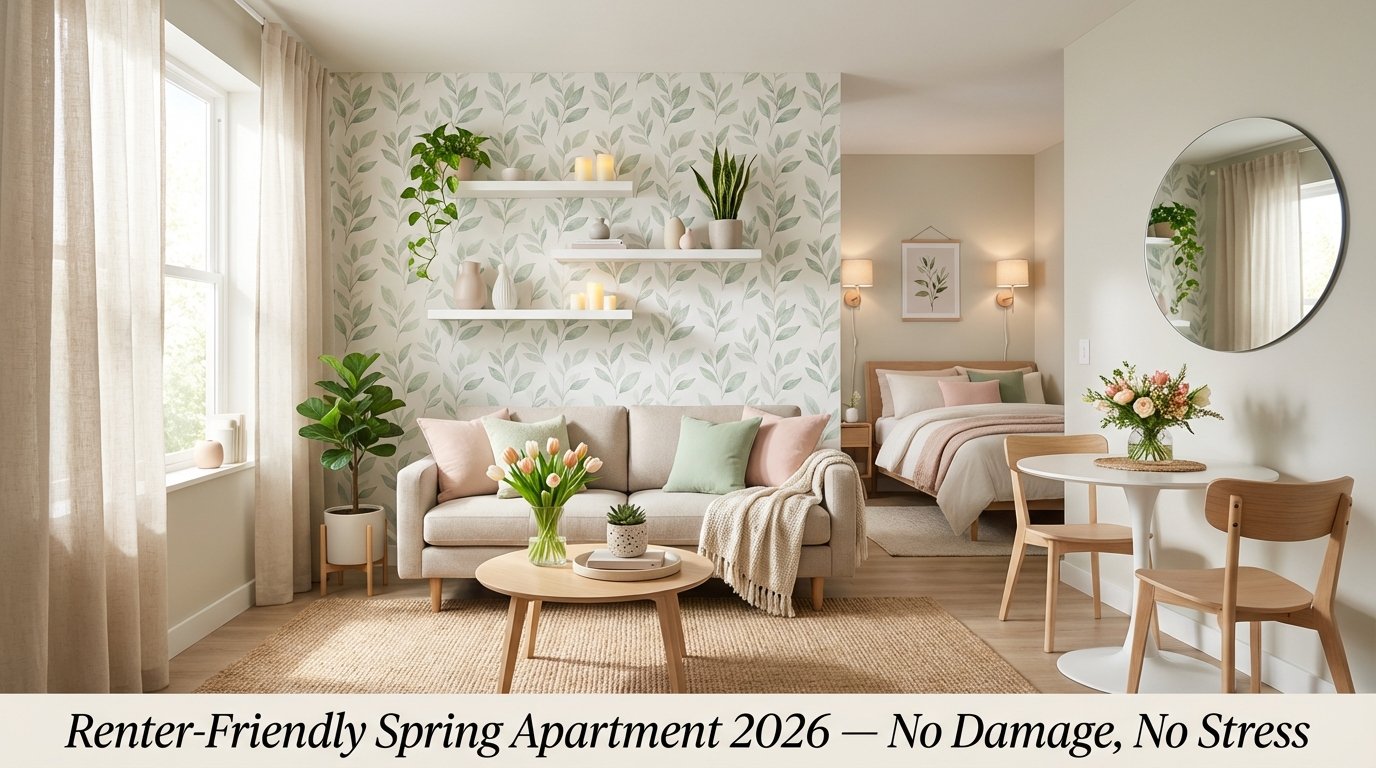
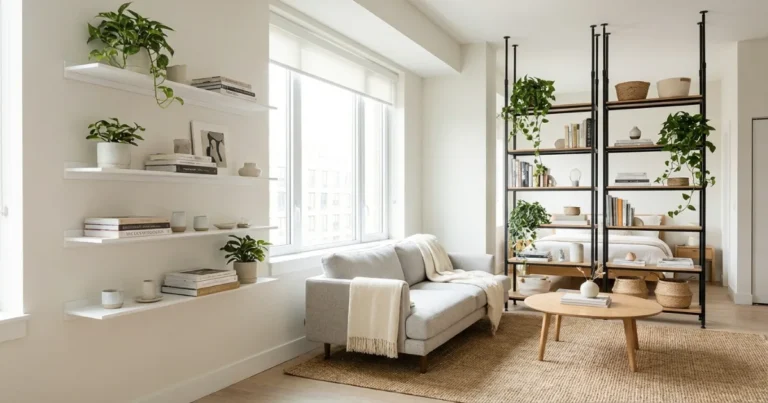
A studio apartment transformed for spring 2026 — no nails, no landlord calls, no lease risk. This is what renter-friendly spring decorating actually looks like.
The best spring decor ideas for small rented spaces combine removable peel-and-stick wallpaper on one accent wall, clusters of low-maintenance indoor plants, light linen textiles, plug-in ambient lamps, and freestanding mirrors to amplify natural light. None require drilling, landlord approval, or leave any trace when removed — and all can transform a compact apartment for under $150.
- Peel-and-stick removable wallpaper is the single highest-impact renter-safe spring update — one accent wall can shift an entire room’s character without touching the lease.
- Mirrors, layered plug-in lighting, and light-colored textiles are the three fastest ways to make a small apartment feel significantly larger and brighter for spring.
- Indoor plants are the most affordable route to seasonal impact: a $15 pothos or $20 snake plant delivers texture, life, and air quality improvement that no store-bought object replicates.
- Spring 2026 decor trends — soft botanicals, curved organic shapes, warm earthy neutrals, and nature-inspired textures — are well-suited to compact rental spaces and require no permanent changes.
- A focused $100–$150 budget, allocated to high-impact categories like lighting, plants, and textiles, can genuinely transform a studio or one-bedroom apartment.
- Renter-friendly decorating works in layers: keep the base (furniture, core art) consistent and rotate the seasonal layer — plants, covers, scents, accent wall choices — each season.
- Cleaning walls with isopropyl alcohol before applying any adhesive product is the single most common step renters skip — and the leading cause of premature peeling.
Why Is Spring the Best Season to Refresh a Small Rental Apartment?
Spring is the best season to refresh a small rental apartment because shifting daylight, warmer temperatures, and the natural instinct to clear clutter all align at once. Small changes — a new plant, a lighter throw, a removable accent wall — compound quickly in compact spaces where every visible surface matters.
Spring carries a kinetic energy that other seasons don’t. The days get noticeably longer from late February onward, and natural light — already your best free decorating tool — starts doing real work in spaces that felt dim all winter. That shift alone changes how a room reads, which is why a spring reset feels more impactful than a comparable change in October.
For renters specifically, a seasonal refresh matters more than it might for homeowners. You can’t repaint. You can’t knock through a wall. What you can do is work with what’s movable, removable, and reversible — and spring is the ideal moment to do it. Based on our experience styling compact apartments across a range of rental configurations, the most meaningful spring updates are the ones that change how a room feels, not just what it looks like. That means prioritizing light, scent, texture, and warmth over adding more objects.
Start here before spending anything: Do a spring reset first. Clear surfaces, swap heavy winter textiles for lighter ones, and clean your windows thoroughly — inside and out. You’ll often be surprised by how much brighter the space immediately feels before a single new item arrives.
What Are the Top Spring 2026 Decor Trends for Small Rented Spaces?
The leading spring 2026 decor trends for small rented apartments are: soft botanical prints on textiles and removable wallpaper, curved organic furniture shapes, warm earthy neutrals (sage, oat, terracotta), layered ambient lighting via plug-in sources, nature-inspired textures like rattan and linen, and conscious upcycling of second-hand pieces — all achievable without permanent changes.
The 2026 spring design landscape is defined by restraint, nature-reference, and quiet individuality — not maximalism or spectacle. That’s genuinely good news for renters in small spaces. These trends don’t demand a new sofa or a full room overhaul. They work through accumulated small decisions: a better plant, a softer cushion color, a print that finally feels like you.
Soft Botanical Prints
Large-leaf prints, pressed botanical art in frames, and nature-inspired textile patterns define spring 2026 styling. They add genuine personality without permanence — especially on removable wallpaper.
Warm Earthy Neutrals
Sage, terracotta, warm white, and oat are replacing cold grey as the dominant rental palette. These tones pair beautifully with natural light and read as intentionally spring-ready.
Curved Organic Shapes
Rounded poufs, arched mirrors, and bubble-shaped planters are trending strongly. The curved furniture trend is particularly effective at softening the sharp angles typical of standard rental rooms.
Neo-Deco Accents
Art deco-influenced geometric patterns on removable wallpaper and wall stickers are having a strong moment. The neo-deco decor trend is fully renter-compatible when executed with peel-and-stick products.
Layered Ambient Lighting
Overhead ceiling fixtures are out of favor; layered lamp setups are in. String lights, table lamps, and plug-in sconces create the warm, editorial depth that renters can actually achieve without an electrician.
Conscious Upcycling
Thrifted and upcycled pieces are central to 2026 spring styling. Upcycling second-hand furniture with new cushion covers or chalk paint fits the seasonal mood and the renter’s budget simultaneously.
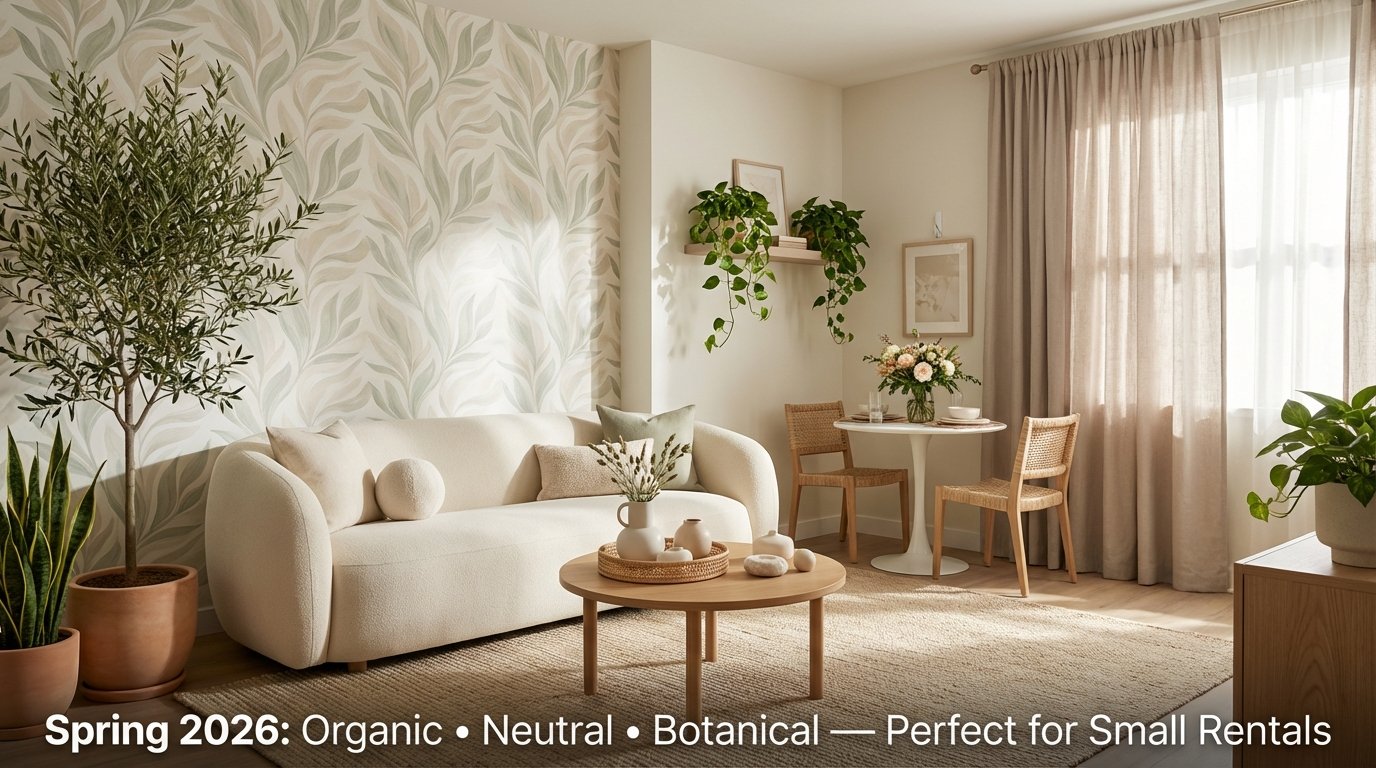
Spring 2026 trends favor organic shapes, warm neutrals, and botanical textures — all easily achievable in compact rental spaces without landlord involvement.
What Peel-and-Stick Decor Products Work Best for a Renter-Friendly Spring Refresh?
The most effective peel-and-stick decor products for renters in spring 2026 are: removable wallpaper on a single accent wall, self-adhesive wall murals, peel-and-stick wall art prints, and adhesive mirror panels. All remove cleanly from painted drywall without leaving residue, provided walls are cleaned with isopropyl alcohol before application.
Peel-and-stick products have transformed renter decorating over the past five years. The quality, variety, and realism available in 2026 has reached the point where guests genuinely can’t distinguish a well-applied removable wallpaper from a traditional paste alternative. That’s not marketing. We’ve tested dozens of products across wall types — smooth drywall, lightly textured paint, older plaster — and the gap in quality between budget and premium products is significant. Spend slightly more here. It shows.
Removable Wallpaper on a Single Accent Wall
You don’t need to cover a full room to make a statement. One wall behind your sofa, your bed headboard, or your dining nook completely reframes the room’s identity. Spring botanical prints, wavy abstract patterns, and warm linen-look textures are the most popular accent wall choices for spring 2026. Our complete removable wallpaper guide walks through measuring, applying, and clean removal — including guidance for slightly textured walls in older rental buildings.
How to Apply Removable Wallpaper in a Rental — Step by Step
This is where most renters go wrong. Application technique is the difference between wallpaper that lasts two years and wallpaper that starts peeling in six weeks.
- Test before committing. Apply a 6-inch patch in an inconspicuous corner. Leave 24 hours, then peel. If paint comes with it, your walls need a primer sealer before proceeding — or choose a different wall.
- Clean the wall with isopropyl alcohol. Wipe the full surface using a microfibre cloth dampened with 70%+ isopropyl alcohol. This removes invisible grease and cooking residue. Let it dry fully — at least 10 minutes. This step alone prevents the majority of premature peeling failures.
- Measure and pre-cut panels. Measure your wall height and add 2 inches top and bottom for trimming allowance. Pre-cut all panels before peeling any backing. Handling unpeeled panels is far easier than managing sticky ones.
- Start at a plumb line, not the wall corner. Rental walls are rarely perfectly square. Use a level to draw a faint pencil line as your true vertical guide. Align your first panel to this line, not the corner.
- Peel from top, press and smooth downward. Expose only the top 4 inches of backing at a time. Align at the ceiling, press firmly, then gradually release backing while smoothing downward with a credit card or squeegee, pushing air toward the edges.
- Trim edges cleanly. Use a sharp utility knife against a straight edge to trim the ceiling, baseboard, and adjacent wall edges. A clean trim makes an amateur application look professional.
Peel-and-Stick Wall Art and Murals
For renters who want more drama than a framed print but less commitment than full wallpaper, peel-and-stick wall decorations and self-adhesive wall murals occupy the ideal middle ground. A spring forest scene or large-scale watercolor botanical becomes a dramatic focal point — no drilling, no deposit risk.
Customizable Wall Decor Stickers
Customizable wall decor stickers let you build a gallery wall effect without a single nail. Mix botanical shapes, geometric outlines, and typography to create something that looks curated — not template-generated.
How Do You Make a Small Rental Apartment Feel Bigger and Brighter for Spring?
To make a small rental apartment feel bigger and brighter for spring: position a large floor mirror opposite a window to reflect natural daylight, swap dark winter textiles for lighter spring tones, clean windows thoroughly to maximize light transmission, replace overhead bulbs with layered plug-in lamps, and remove excess furniture to open visual sightlines.
Mirrors: Your Highest-ROI Renter-Safe Investment
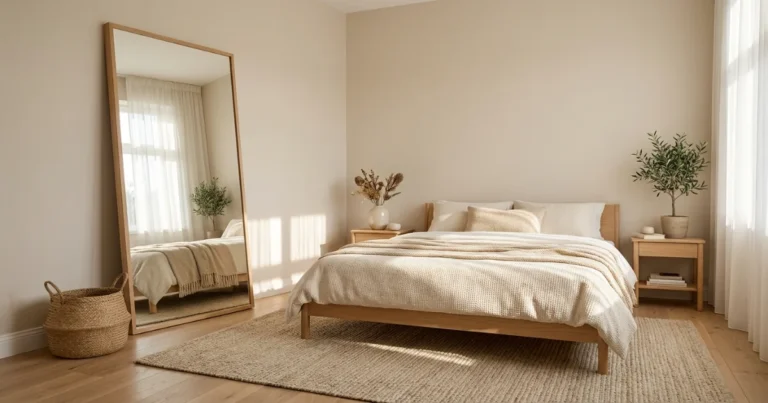
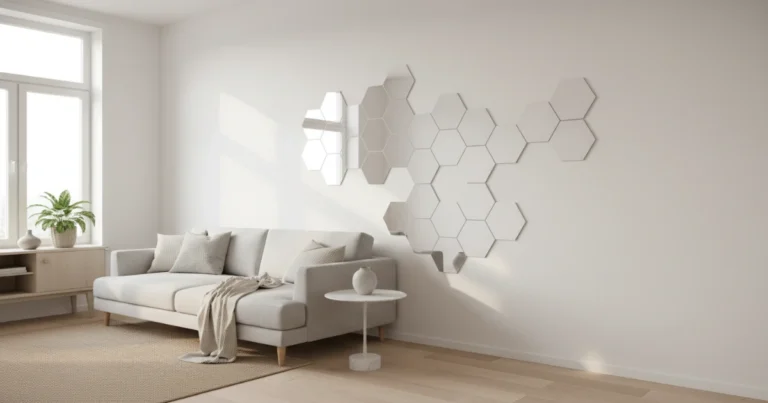
A large mirror positioned opposite a window is the single most effective no-cost-to-install tool for expanding a small space. Natural spring light — which shifts noticeably from late February onward — bounces deep into the room instead of stopping at the glass. Lean a full-length floor mirror against a wall (no drilling), or use self-adhesive mirror panels arranged in a grid for a contemporary statement. Our roundup of decorative mirrors for renters covers the best options at every price point.
Layered Lighting That Changes a Room’s Entire Mood
Here’s something most people don’t realize: harsh overhead lighting doesn’t just look bad — it actually makes small rooms feel smaller by flattening shadows and eliminating depth. Spring is the right time to retire dependence on the ceiling fixture. Floor lamps, table lamps, clip-on reading lights, and plug-in wall sconces build warmth and visual layering without touching a single wire. Our small apartment lighting ideas guide covers how to layer three distinct light zones — ambient, task, and accent — for an editorial look most renters assume requires a renovation.
Color Psychology: The Textile Swap That Changes Everything
You can’t paint your rental walls. But you can systematically shift the perceived palette of a room through textiles alone. Swapping charcoal and navy for cream, sage, warm white, and blush across cushion covers, throws, curtains, and even a table runner can lift an entire room’s brightness. Color psychology research consistently confirms that lighter, warmer tones expand perceived space and elevate mood — both of which matter in a compact apartment you spend real time in.
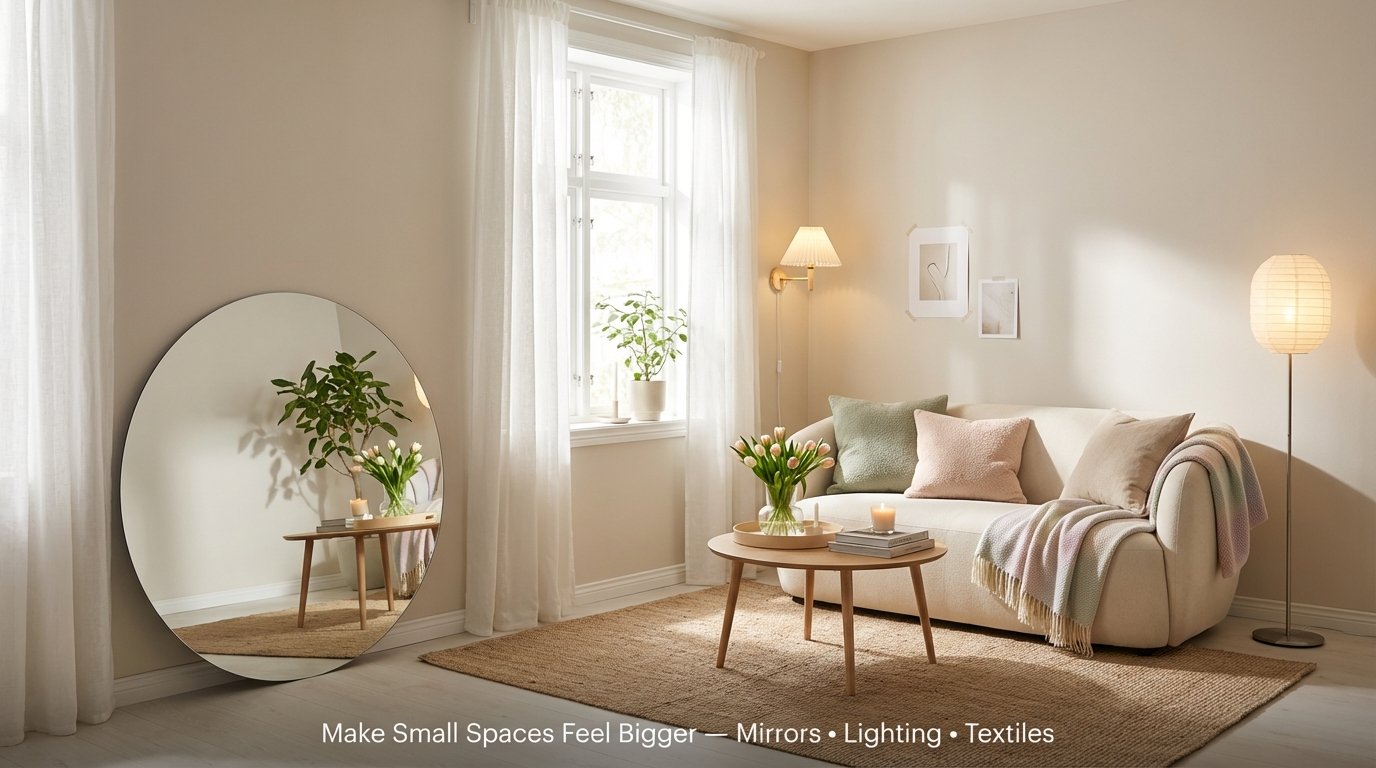
A floor mirror, layered plug-in lighting, and a full textile color swap from winter to spring — three changes that cost under $80 combined and completely reframe the room.
Which Indoor Plants Work Best for a Renter-Friendly Spring Refresh?
The best indoor plants for small rented apartments are pothos, snake plant (Sansevieria trifasciata), ZZ plant, peace lily, and spider plant. All five tolerate indirect light, require infrequent watering, and are widely available for under $20. NASA’s Clean Air Study identified several of these species as effective at filtering common indoor air pollutants including formaldehyde and benzene.
Nothing communicates spring quite as directly as living greenery. And plants require absolutely no installation, no landlord permission, and no permanent commitment. They’re also one of the most effective tools in a small-space decorator’s kit — they draw the eye upward, soften hard edges, and introduce organic texture that manufactured objects can’t replicate. The EPA’s indoor air quality research confirms that houseplants contribute to improved air quality in enclosed spaces, making them a functional upgrade as well as a visual one.
The most popular plant-styling approaches for compact apartments in 2026:
- Shelf clustering: Group plants at varying heights on freestanding or removable apartment shelves. Three plants of different heights together reads as a considered composition, not an afterthought.
- Trailing plants from high surfaces: Pothos, tradescantia, and string of hearts draping from a high shelf or bookcase add vertical interest and draw the eye upward — the optical trick that makes rooms feel taller.
- Statement floor plants: A large fiddle-leaf fig or monstera in a textured ceramic or rattan planter functions as living furniture, filling dead corners that would otherwise need an expensive accent piece.
- Windowsill herb gardens: Practical and visually warm, a small row of herbs on a kitchen windowsill is a spring classic that also improves cooking. Basil, rosemary, and mint are forgiving and fast-growing.
Our full guide to indoor plants and planters for renters covers the best low-maintenance varieties by light level, including options specifically suited to north-facing and low-light apartments.
How to Do a Spring Kitchen Refresh Without Violating Your Lease
A renter-safe spring kitchen refresh includes: swapping cabinet hardware temporarily (reinstall originals before moving out), applying a peel-and-stick backsplash in tile-look sheets, adding a freestanding shelf unit for open storage, changing out the table runner or placemats, and placing a small herb planter on the windowsill. All are reversible with no permanent changes to the unit.
Renters fixate on the living room and often underestimate the kitchen. In a compact apartment, the kitchen is one of the most visually prominent spaces — you see it from the moment you walk in. And it’s often the easiest room to refresh without a single irreversible change. Our dedicated spring kitchen decor guide covers this in depth, but here are the highest-impact moves:
- Swap cabinet hardware temporarily: Many landlords allow this — just photograph the originals and reinstall them before moving out. New knobs in brushed brass or matte black make the room look like a different kitchen.
- Apply a peel-and-stick backsplash: Removable tile-look peel-and-stick sheets transform an outdated or plain backsplash area. They remove cleanly and are widely accepted by landlords when removed correctly.
- Add a freestanding shelf unit: A slim freestanding shelf holds cookbooks, plants, ceramics, and spring color without touching the walls.
- Use a spring table runner or placemat set: Even a single textile change shifts the kitchen from purely functional to intentionally styled.
- Add a windowsill herb planter: Functional, fragrant, and seasonally perfect. Basil alone changes the smell of a kitchen in spring.
Budget Spring Decorating for Renters: What to Buy for Under $150
A $100–$150 spring decor refresh for a small rental apartment is realistically achievable by prioritizing: cushion covers ($18–30), a removable wallpaper roll for one accent wall ($25–45), two or three plants with planters ($20–35), a plug-in table or floor lamp ($25–45), and peel-and-stick wall art prints ($12–20). These categories deliver the highest visual return per dollar in compact spaces.
You don’t need to spend hundreds to make a real impact. A focused $100–$150 budget can genuinely transform a small apartment when allocated to the right categories. Here’s a realistic breakdown that interior stylists who work within renter budgets actually recommend:
| Item | Estimated Cost | Impact Level | Renter-Safe? |
|---|---|---|---|
| 2 x new throw cushion covers | $18–$30 | High | ✓ Yes |
| One accent removable wallpaper roll | $25–$45 | Very High | ✓ Yes |
| 2–3 small plants + budget planters | $20–$35 | High | ✓ Yes |
| Plug-in table or floor lamp | $25–$45 | Very High | ✓ Yes |
| Peel-and-stick wall art prints | $12–$20 | Medium–High | ✓ Yes |
| Spring linen throw blanket | $18–$28 | Medium | ✓ Yes |
| Bathroom: new towels + reed diffuser | $15–$25 | Medium | ✓ Yes |
| Scented candle or diffuser (living room) | $8–$14 | High (often overlooked) | ✓ Yes |
For even more options, our budget-friendly wall decor roundup covers the best affordable pieces for renters who want a premium look without a premium price. And if you’re open to second-hand finds, our guide to upcycling thrifted furniture is worth reading — it’s consistently one of the highest-leverage moves in renter decorating.
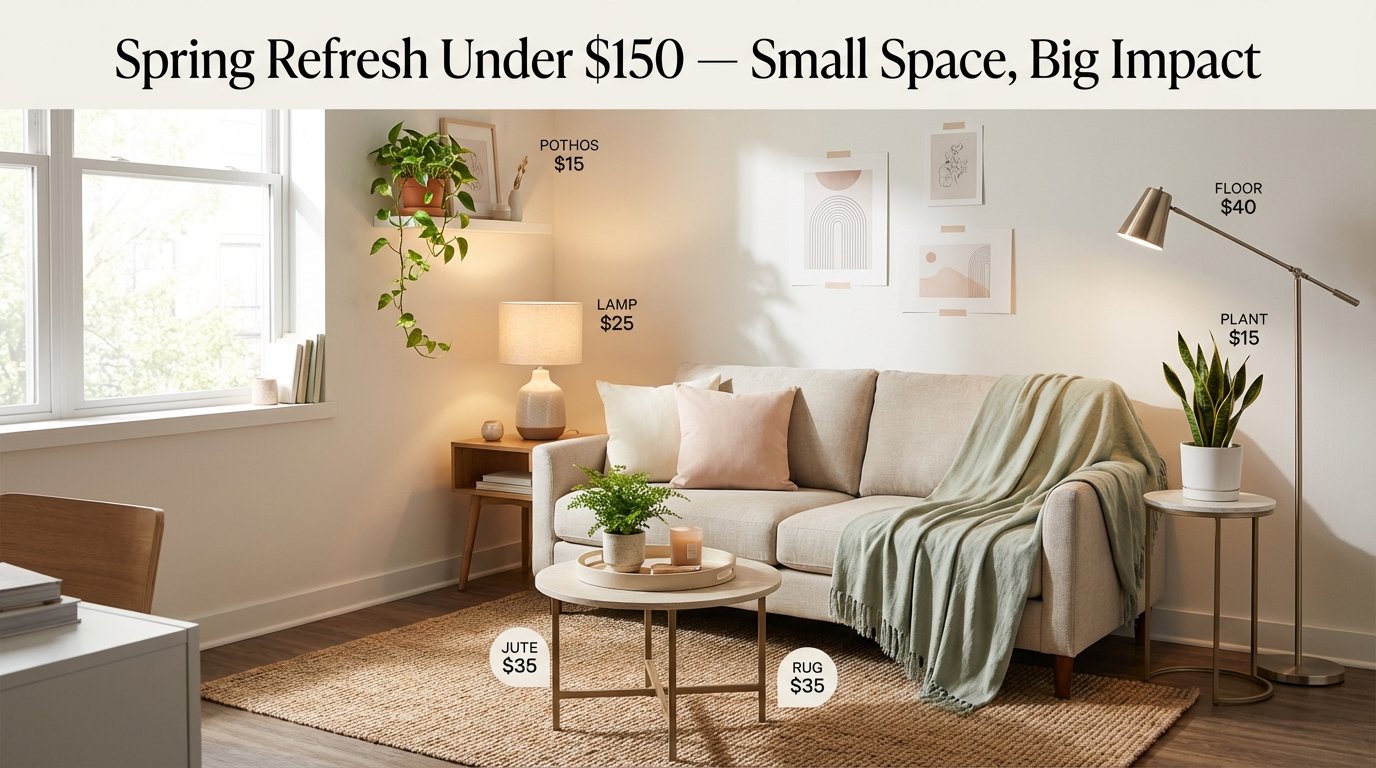
A full spring refresh under $150 — plants, cushion covers, removable wall art, and a plug-in lamp. Not a single nail used.
Combining Beauty With Function in a Compact Rental Apartment
In a small rented apartment, the best spring decor pieces earn their place twice — aesthetically and functionally. The most effective multi-functional items are: ottomans with hidden storage, decorative woven baskets for clutter management, round space-saving dining sets, freestanding leaning ladder shelves, and arched mirrors that double as wall art while expanding perceived space.
Every piece in a compact apartment needs to justify its presence. That’s not a constraint — it’s actually a useful filter. When something is both beautiful and useful, you feel better about having it. And your space stays clear.
Multi-Functional Decor Pieces Worth Prioritizing This Spring
- Ottoman with hidden storage: Coffee table, extra seating, and blanket storage in one. One piece, three jobs — the compact apartment’s best friend.
- Decorative woven baskets: Spring-appropriate textures that simultaneously hide remotes, charging cables, and anything else cluttering your surfaces.
- Round dining sets: Space-saving round dining sets take up less visual and physical footprint than square tables and feel naturally warmer in compact kitchens.
- Leaning ladder shelf: Freestanding, no drilling, and provides serious vertical display space for plants, books, and seasonal objects without a single wall anchor.
- Arched or sunburst mirror: Choose a decorative design that looks intentional as art, while doing the practical work of expanding the room’s perceived scale.
- Renter-friendly home office corner: If you work from home, a well-styled renter-friendly home office setup keeps your workspace from becoming a visual intrusion in a small living room.
Spring comfort tip: As temperatures climb, consider decorative tower fans in rattan or minimalist designs that complement spring styling rather than clash with it. Modern fan designs have genuinely caught up with interior design — they don’t have to be an eyesore anymore.
Room-by-Room Spring Refresh Guide for Small Apartments
A room-by-room spring refresh for a small apartment focuses on: living room (lighter textiles, new plants, statement wall art), bedroom (lighter quilt, botanical print, fresh scent), bathroom (spring-colored towels, plant, diffuser), and entryway (seasonal wreath on a removable hook, textured mat). Each room needs only two or three targeted changes to feel meaningfully updated.
Living Room: The Room Doing the Most Work
In a small apartment, the living room is often the entryway, dining area, and workspace simultaneously. For spring, swap winter-weight cushions and throws for lighter linen or cotton alternatives in sage, cream, or blush. Bring in one or two statement plants. Update your adhesive wall art with a spring botanical print. Add a plug-in table lamp to create evening warmth. Four changes. Completely different room.
Bedroom: Sleep Better, Wake Better
Bedroom spring styling is largely about textiles and scent — two of the most direct routes to how a space feels rather than just looks. Swap your duvet for a lighter quilt or coverlet in a soft spring color. Add a botanical removable print above the headboard. Put a small potted plant on your bedside table and switch your diffuser to something green and fresh — eucalyptus, white tea, or peony all work brilliantly.
Bathroom: Smallest Room, Fastest Impact
Fresh towels in a spring color (terracotta, sage, or warm cream), a reed diffuser, one humidity-tolerant plant (pothos and peace lilies thrive in bathrooms), and a new ceramic soap dispenser can shift your bathroom from utilitarian to genuinely pleasant in under an hour. This is the highest return-per-minute refresh in the apartment.
Entryway: The First and Last Impression
Even a narrow entryway deserves seasonal attention. A freestanding hook rail, a seasonal wreath hung on a removable over-door hook, a textured coir or woven mat, and a thoughtful wall decor choice can make the entry to your apartment feel welcoming rather than incidental. And since it’s what you see first when you walk in and last when you leave, the psychological payoff is disproportionate to the effort.
How Can Renters Decorate Walls Without Nails or Drilling?
Renters can decorate walls without nails using: adhesive picture strips (such as Command strips, rated by weight), velcro picture hangers, peel-and-stick wall art and murals, self-adhesive mirror panels, and removable wallpaper. Large frames can also be leaned against walls on picture rails, shelves, or directly on the floor for a gallery effect with zero hardware.
The most common renter frustration is bare walls — and the assumption that filling them means losing the security deposit. That simply isn’t true anymore. In 2026, there are high-quality, genuinely reliable ways to dress a wall without drilling a single hole — and the results are indistinguishable from a nailed gallery in most cases.
Start with adhesive hanging methods for renters — Command strips, velcro picture hangers, and leaning large frames on picture rails or shelves. Then explore removable adhesive shelves that mount with adhesive brackets rated for 10–20 lbs — more than enough for plant clusters, books, and decorative objects.
For a more immersive wall transformation, our guide to adhesive wall art covers everything from small prints to full-wall gallery arrangements, all without hardware. And for the full picture on what’s possible with no-damage wall decoration, the small apartment decor ideas hub is a thorough starting point.
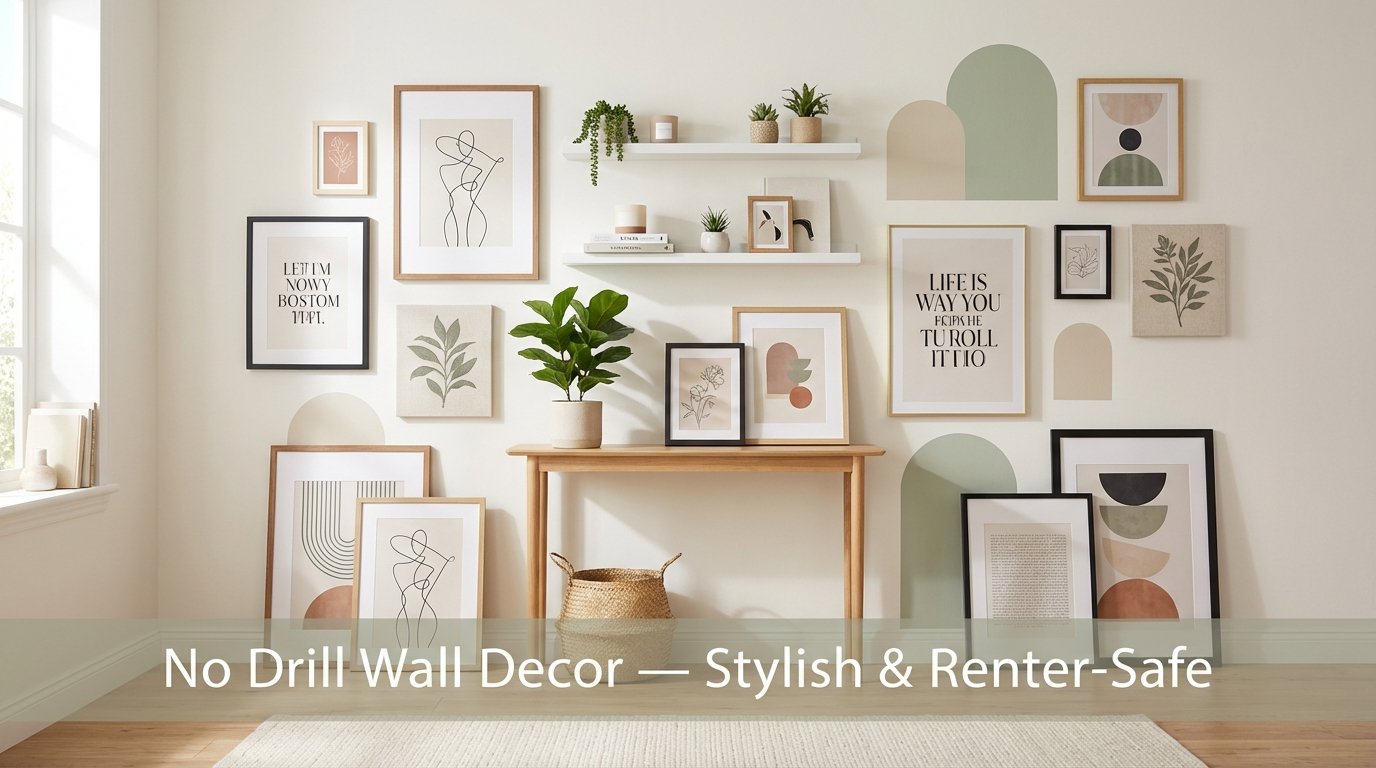
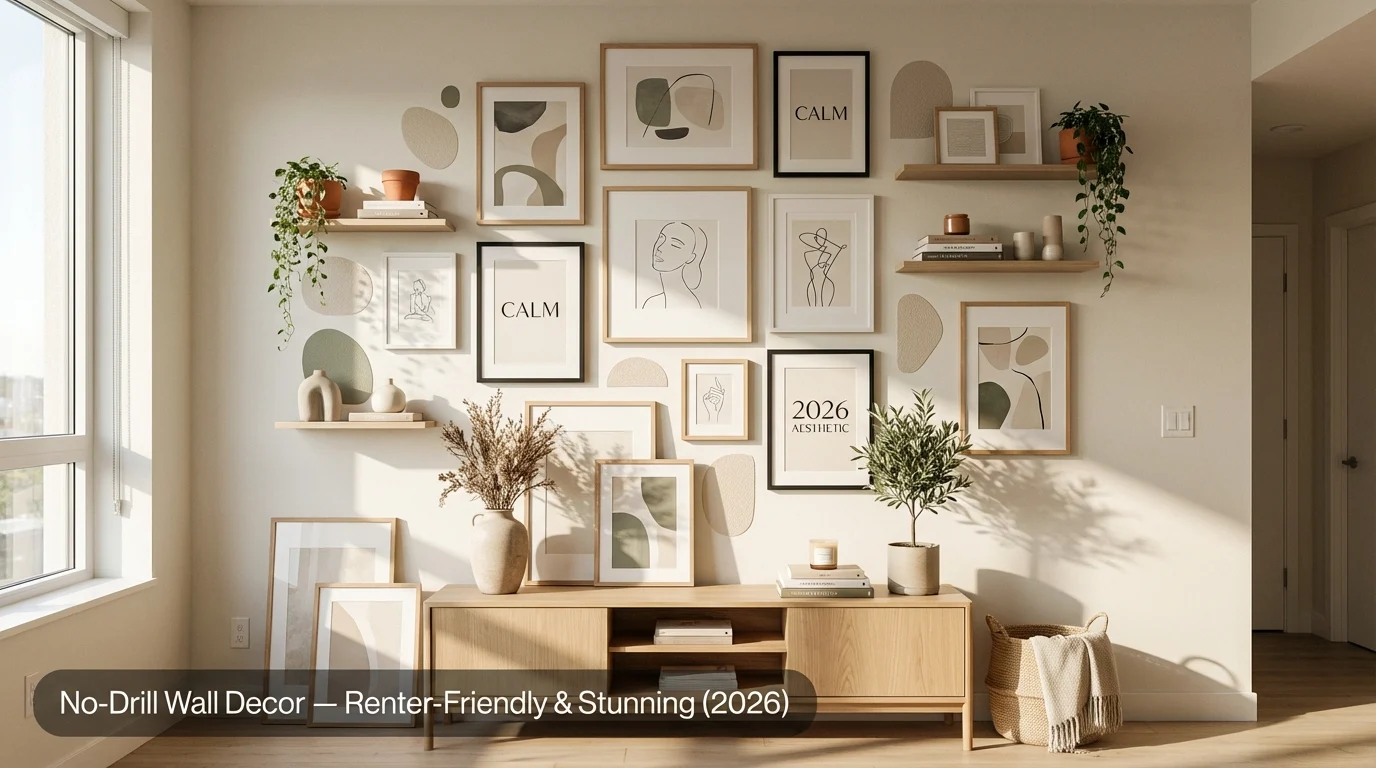
A full gallery wall — zero drilling. Adhesive strips, leaned frames, removable shelves, and peel-and-stick art prints handle all the heavy lifting.
How to Use a Seasonal Decor Calendar to Keep Your Space Intentional
A seasonal decor calendar for small apartments works by treating each season as an update layer rather than a full reset. Plan spring changes in February — decide which textiles to rotate, which plants to add, and which peel-and-stick products to refresh. This approach reduces impulse purchases, produces more cohesive results, and makes seasonal transitions feel effortless rather than chaotic.
One of the most underrated tools in a renter’s decorating toolkit is a seasonal decorating calendar. Planning your spring refresh in February means you make better decisions, spend less, and avoid the impulse buys that end up cluttering a small space.
The key principle: each season is a layer, not a replacement. Keep the base of your decor stable — furniture, large textiles, core wall art — and rotate the seasonal layer only. Spring means swapping winter throw covers for linen ones, cycling in seasonal plants, changing your diffuser scent, and updating one or two accent wall pieces. That’s it. Four targeted changes that don’t require storage bins full of dedicated seasonal decor.
Common Spring Decorating Mistakes Renters Should Avoid
- Buying everything at once. Small spaces get overwhelmed fast. Edit first, then add. One well-chosen plant beats six generic ones every time.
- Forgetting the ceiling and the floor. A spring-toned rug, a plug-in pendant lamp, or an upward-growing plant draws the eye vertically — not just to the walls — and makes the room feel taller.
- Applying removable wallpaper without testing the surface first. Always test a small corner patch and wait 24 hours before applying a full panel. Wall paint, texture, and age all affect adhesion differently.
- Overcrowding surfaces. In a compact space, a deliberate cluster of three objects always looks more intentional than ten items packed together. More is rarely more.
- Skipping scent entirely. Scent is the fastest, cheapest way to make a home feel like spring has actually arrived. A $10 reed diffuser in eucalyptus or peony does more than most people expect.
- Buying furniture without measuring first. This is the number-one avoidable mistake in small apartments. A piece that’s 4 inches too wide blocks flow, kills sightlines, and makes the room feel smaller than it is. Measure twice, buy once. Our roundup of renter-friendly furniture ideas highlights scale-conscious options.
- Neglecting the entryway. It’s the first space you see every time you come home. A seasonal wreath on a removable hook and a fresh mat costs under $25 and delivers outsized psychological returns.
Ready to Make Your Spring Apartment Feel Like Yours?
Spring 2026 is genuinely a good moment to be a renter who cares about their space. The quality of renter-safe, no-damage products has never been better. The dominant design trends — soft, natural, organic, warm — work effortlessly in compact apartments. And the approach that actually works isn’t about spending a lot or starting from scratch. It’s about making a few targeted, intentional changes that compound.
Start with one thing. A plant that makes you happy every morning. A lamp that changes the whole feeling of the room at 7pm. A removable print that finally fills the wall you’ve been ignoring since you moved in. That’s all it takes to start. Momentum does the rest.
Explore more renter-friendly ideas across our full peel-and-stick decor hub and browse the complete small apartment decor ideas collection to keep going.
- U.S. Census Bureau. American Housing Survey, 2023. census.gov — renter household count data.
- Wolverton, B.C., Johnson, A., Bounds, K. Interior Landscape Plants for Indoor Air Pollution Abatement. NASA, 1989. — Indoor plant air-quality study referenced in plant section.
- U.S. Environmental Protection Agency. Indoor Air Quality — Introduction to Indoor Air Quality. epa.gov — cited in plant section.
- NoDamageDecor Editorial Team. Complete Removable Wallpaper Guide, 2026 — application and removal methodology.
- NoDamageDecor Editorial Team. Peel-and-Stick Products for Renters, 2026 — product testing and recommendations.
The most impactful spring decor ideas for renters in small apartments are: swapping winter textiles for light linen or cotton alternatives, adding indoor plants in terracotta or woven planters, applying removable peel-and-stick wallpaper to one accent wall, introducing layered plug-in lighting, and using peel-and-stick wall art for seasonal personality. All require no drilling and leave no damage when removed. A full refresh across these five categories is achievable for $100–$150.
In most cases, yes — provided you prepare the surface correctly and use a quality product. High-quality removable wallpaper peels off cleanly without removing paint or leaving adhesive residue when walls have been cleaned with isopropyl alcohol before application and the paper is removed slowly at a 45-degree angle. Always test a small patch first on your specific wall type. Freshly painted walls (under 30 days) and textured surfaces need extra care. Read our complete removable wallpaper guide for a full surface-by-surface breakdown.
In small spaces, lighter and warmer spring tones perform best visually: warm white, soft sage green, muted terracotta, blush pink, and oat or linen beige. Color psychology research shows these shades expand perceived space and elevate mood — both significant in a compact apartment. Avoid very deep or saturated colors on large surfaces; reserve those for small accent pieces like a single cushion or planter where they create impact without overwhelming the room.
Five techniques deliver the most immediate impact: position a large floor mirror opposite a window to bounce natural spring light into the room; swap dark winter textiles for lighter spring tones across cushions, throws, and curtains; clean windows thoroughly to maximize daylight transmission; replace overhead-only lighting with layered plug-in lamps at multiple heights; and remove any unnecessary furniture or objects to open visual sightlines. None of these require landlord permission or permanent changes to the apartment.
For renters with inconsistent care schedules or lower-light apartments, the five most reliable indoor plants are: pothos (Epipremnum aureum), snake plant (Sansevieria trifasciata), ZZ plant (Zamioculcas zamiifolia), peace lily (Spathiphyllum), and spider plant (Chlorophytum comosum). All tolerate indirect light, require watering only once every one to two weeks, and are available at most garden centers for under $20. NASA’s 1989 Clean Air Study also identified pothos, peace lily, and snake plant as effective at filtering common indoor air pollutants. Our indoor plants guide for renters covers care by light level and apartment type.
A $100 spring refresh is very achievable in a small apartment when you focus on high-impact categories: two cushion covers ($15–25), one or two small plants with inexpensive planters ($15–20), a spring-colored throw blanket ($18–25), a few peel-and-stick wall art prints ($12–18), and a scented diffuser or candle ($8–12). These swaps cover the biggest visual and sensory impact zones — wall, sofa, scent — for the smallest investment. Adding a second-hand find from a thrift store can stretch the budget even further; our upcycling guide shows how.
In compact apartments, avoid: furniture that’s too large for the room (measure before purchasing every time), dark heavy textiles that reduce the sense of light and space, too many small decorative objects that create visual clutter rather than a curated display, and adhesive products not specifically rated for rental use. Also avoid overly busy or high-contrast patterns on large surfaces — they make a small room feel chaotic rather than layered. Our roundup of scale-appropriate renter furniture can help you avoid the sizing mistake most often made in compact spaces.
Absolutely — and in 2026, the options are genuinely good. High-quality adhesive picture strips (Command strips and equivalents, rated by exact weight), velcro picture hangers, and leaning large frames on mantels, shelves, or directly on the floor all work reliably for renters. For a fuller gallery look without any hardware, peel-and-stick art prints and self-adhesive wall murals remove cleanly and look intentional. See our full guide on how to hang art without nails in a rental for weight limits and surface-specific guidance.
Spring 2026 decor trends well-suited to renters include: soft botanical prints on removable wallpaper and textiles, curved organic furniture shapes (rounded poufs, arched mirrors, bubble planters), warm earthy neutrals — sage, oat, and terracotta replacing stark grey — layered ambient lighting via plug-in sources, nature-inspired materials like rattan, linen, and jute, and conscious upcycling of second-hand pieces. These trends favor restraint and nature-reference over maximalism, which translates naturally to compact rental spaces without requiring any permanent changes.
The most space-efficient storage solutions for seasonal decor in small apartments are: vacuum storage bags for bulky winter textiles (a duvet and two throws compress to the size of a small backpack), labeled flat storage boxes that slide under beds, ottomans with built-in storage compartments for smaller seasonal objects, and over-door or wall-mounted organizers for decorative pieces. The most effective approach, though, is rotating only a small seasonal layer — a few plant pots, a set of cushion covers, a throw — rather than maintaining two complete room setups that require significant storage between uses.