Best Portable Air Conditioners & Fans for Small Apartments (2026 Guide)
Summer in a small apartment without central air is a special kind of misery. You wake up sweating, your bedroom feels like a greenhouse by noon, and the last thing you want to do is spend three figures on something a landlord will never approve. Sound familiar?
The good news is that the portable cooling market in 2026 has genuinely leveled up. You have real options — slim, whisper-quiet, surprisingly stylish options — that require zero permanent installation, won’t void your lease, and won’t look like an eyesore next to your carefully curated apartment decor.
Whether you’re cooling a 300-square-foot studio, a sun-blasted bedroom, a compact home office, or just trying to survive the kitchen in August, this guide covers everything you need to choose the right portable air conditioner or fan. We’ll break down what actually matters, flag the common rookie mistakes, and help you find a cooling solution that fits your space, your budget, and your vibe.
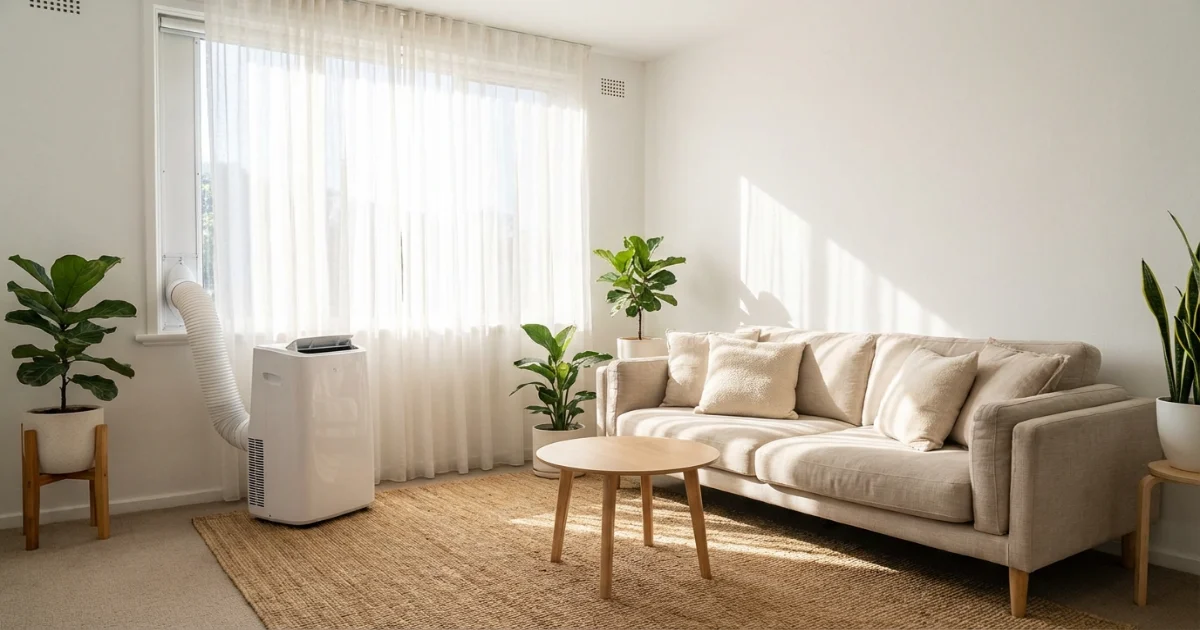
For most small apartments and studios under 400 sq ft, a dual-hose portable air conditioner (8,000–12,000 BTU) is the most effective cooling solution. If noise or budget is a concern, a tall tower fan with a built-in air purifier is the next best option. For bedrooms, prioritize noise level (under 50 dB). For living rooms and studios, prioritize BTU coverage and energy efficiency. No window? A bladeless tower fan or evaporative cooler is your best bet.
- Portable ACs cool faster and more effectively than fans, but they require a window for venting.
- Dual-hose portable ACs are more efficient than single-hose models — worth the slight price premium.
- Tower fans are the best renter-friendly, no-installation cooling option for small spaces and bedrooms.
- Noise matters more than you think — especially for bedrooms and home offices. Aim for under 50 dB.
- Window kits that come with portable ACs are designed to be temporary and renter-safe — no drilling needed.
- Energy efficiency (EER/CEER ratings) should be a key factor; inefficient units can spike your electricity bill.
- Style and footprint matter in small apartments — look for slim, neutral-toned units that blend in.
- Pairing your cooling setup with good small apartment lighting makes your space feel cooler and more comfortable overall.
Why Portable Cooling Works Well for Small Apartments
Small apartments are actually ideal candidates for portable cooling. You’re not trying to cool a whole house — you’re managing one room, maybe two. That’s where portable units shine: they’re targeted, efficient for their output, and ready to move wherever you need relief.
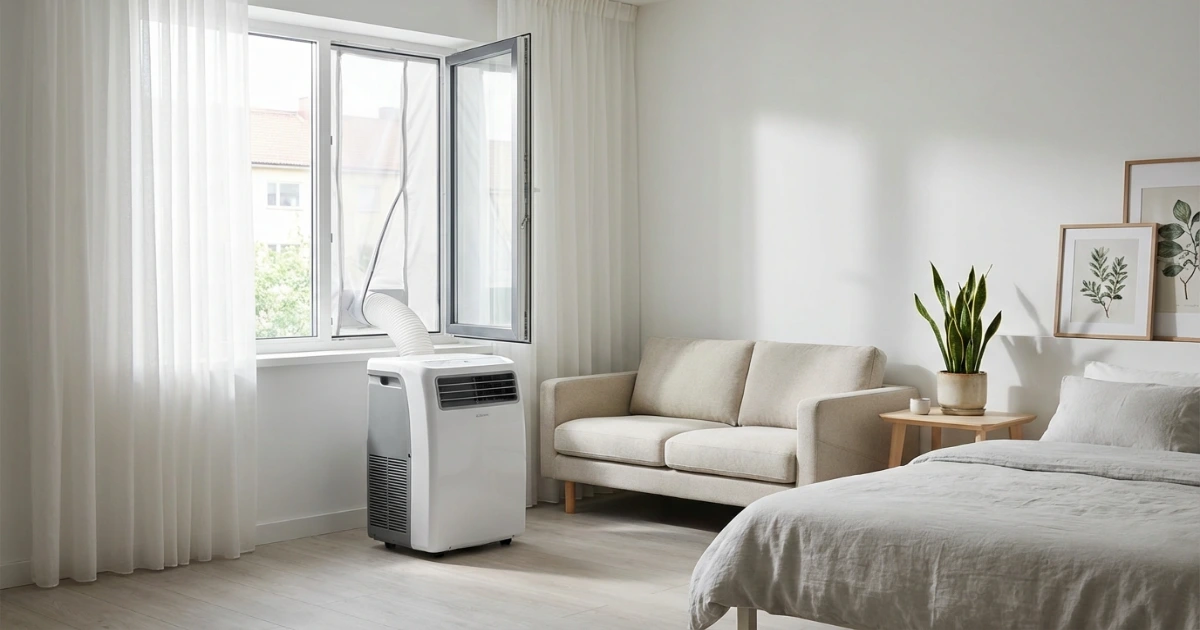
Most small apartments in urban buildings are older, which means no built-in central air and window configurations that don’t always play well with window-mount ACs. Portable units solve this elegantly. You set them up in minutes, vent through a sliding or standard window with a flexible hose kit, and you’re done. No tools. No lease violations. No awkward conversations with your landlord.
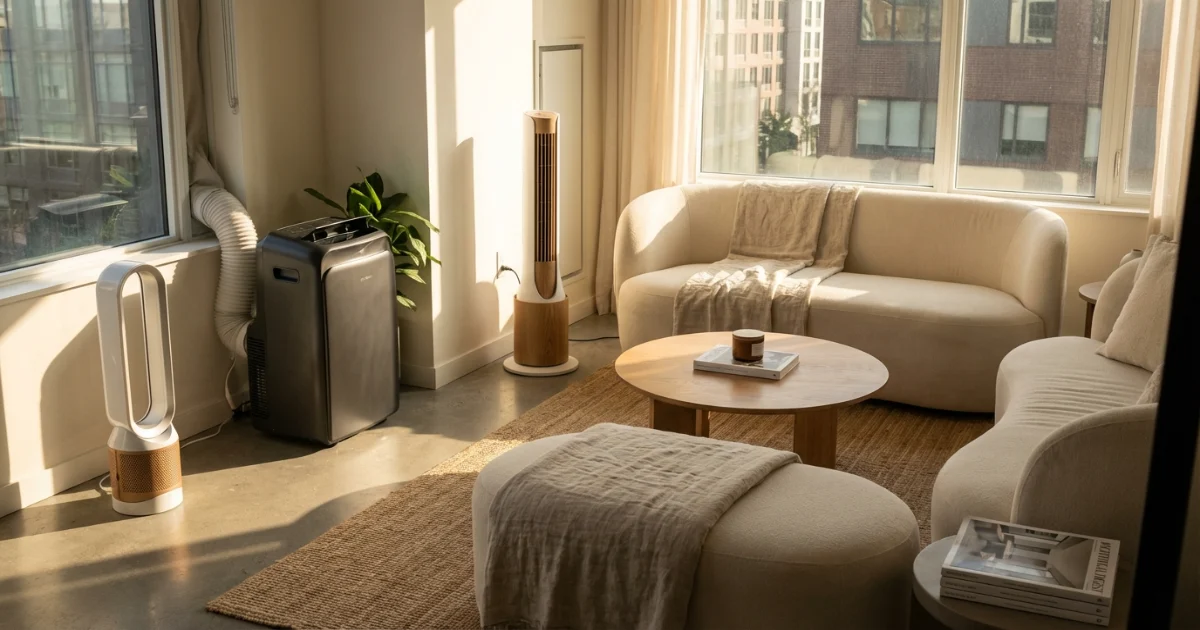
And beyond function, today’s portable coolers are genuinely designed to fit modern living spaces. You’ll find models in matte white, slate gray, and even soft stone tones that blend naturally into minimalist or Scandinavian-inspired interiors — the same aesthetic you’d find on NoDamageDecor.com.
💡 Pro Tip Cooling your apartment doesn’t start and end with a machine. Blackout curtains on west-facing windows, strategic use of ceiling fans, and good cross-ventilation can reduce your reliance on power-hungry units and lower your energy bill significantly.
Portable Air Conditioners vs. Fans: Which Is Better for a Small Apartment?
This is the first real decision point. Both categories have their place — it’s about matching the right tool to your specific situation.
❄️ Portable Air Conditioner
- Actually lowers room temperature
- Effective in high humidity climates
- Works in rooms that retain heat (top floors, direct sunlight)
- Dehumidifies as it cools
- Higher upfront cost ($250–$650)
- Requires window venting
- Louder than most fans (52–60 dB)
- Uses more electricity
🌬️ Tower Fan / Cooling Fan
- Circulates and moves air (doesn’t lower temp)
- Quiet — some models under 30 dB
- Works without a window
- Extremely low energy use
- Budget-friendly ($40–$200)
- Lightweight and easy to store
- Great for bedrooms and home offices
- Limited effectiveness in extreme heat or humidity
The honest answer: if your apartment regularly hits above 80°F (27°C) in summer, a fan alone won’t cut it. You need something that actively removes heat from the air. That’s a portable AC. If you’re in a mild climate or just need air movement at night, a quality tower fan is all you need.
Many renters end up with both — a portable AC in the main living area and a tower fan in the bedroom — which is actually a very smart approach to zoned cooling without a central system.
What to Look for Before You Buy
Room Size and BTU Rating
BTU (British Thermal Units) is how cooling capacity is measured. For most small apartments, here’s the rough guide: studios and single rooms under 250 sq ft → 8,000 BTU; 300–400 sq ft → 10,000–12,000 BTU; 400–550 sq ft → 12,000–14,000 BTU. Don’t oversize — a unit that’s too powerful will cool quickly but leave your air humid and clammy.
Venting Needs
Almost every portable AC needs to exhaust hot air somewhere. Most come with a window venting kit that fits standard sliding or double-hung windows. Casement or jalousie windows require a separate kit. If you have zero window access, a portable AC is not for you — look at evaporative coolers or fans instead.
Window Compatibility
Check the height range of the included window kit before buying. Most kits fit windows between 27–47 inches tall, but some apartments have unusually short or tall windows. Measure first. The good news: modern window vent kits use no drilling and leave no damage — completely renter-safe.
Noise Level
Noise is huge, especially for bedrooms and open-plan studios. A good portable AC runs at around 52–56 dB on high — about the volume of a quiet conversation. The quietest tower fans run at 26–35 dB on low, which is barely perceptible. Always check the manufacturer’s dB specs and look at verified user reviews mentioning sleep use.
Energy Efficiency
Look for the CEER (Combined Energy Efficiency Ratio) rating. A CEER of 10 or above is considered good. Energy Star certified models can cut cooling costs by up to 15%. In a small apartment, this adds up over a summer — especially if you’re running the unit eight or more hours a day.
Style and Footprint
Small spaces demand thoughtful aesthetics. A bulky beige box crammed in the corner of a stylish studio is going to bother you every day. Fortunately, many 2026 models come in slim profiles and neutral palettes. Tower fans in particular tend to have elegant, minimal silhouettes that disappear into a well-designed room, similar to how curved furniture adds softness without demanding attention.
Storage
In a small apartment, off-season storage is a real constraint. Tower fans are slim enough to store in a closet. Portable ACs are bulkier — most are about the size of a carry-on suitcase — so plan for where it goes in October.
Ease of Moving
Look for built-in caster wheels (for portable ACs) and a carry handle (for fans). Being able to roll your unit from the living room to the bedroom takes about 30 seconds and makes a huge quality-of-life difference.
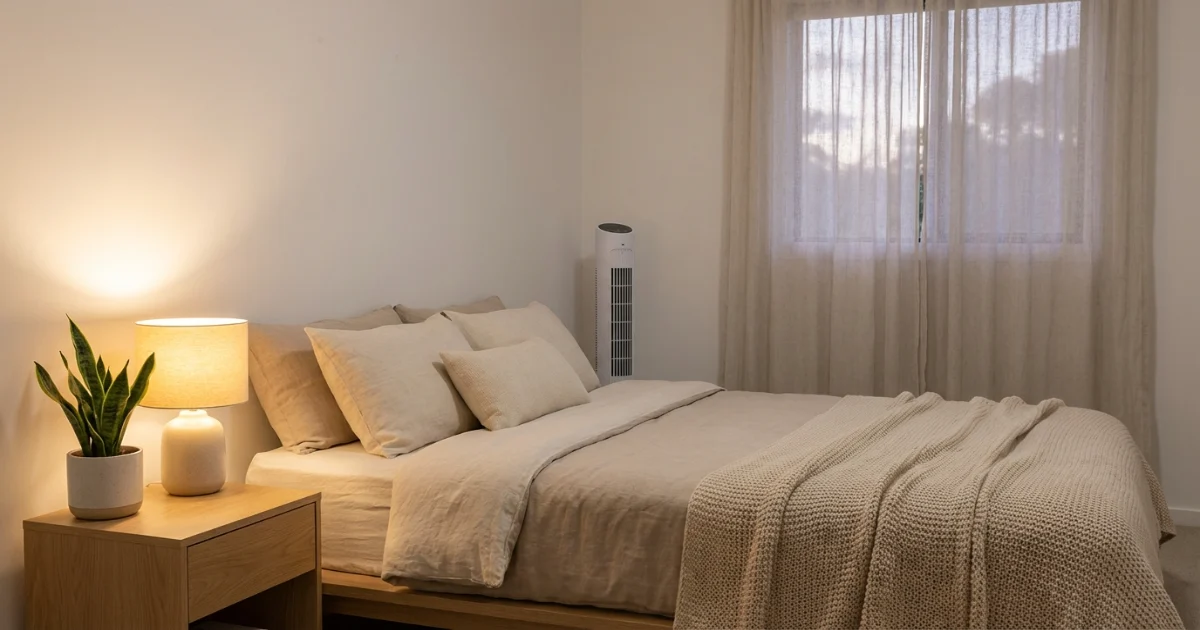
Best Portable Air Conditioners for Small Apartments (2026)
These picks are based on performance, renter-friendliness, noise level, design, and real-world reviews for spaces under 500 square feet.
LG LP0821GSSM — 8,000 BTU Dual Inverter
The benchmark for small-apartment portable ACs. Dual-hose design, inverter compressor for variable speed cooling, and a genuinely quiet 44 dB on low. Slim footprint and matte finish look far better than most competitors.
✅ Quiet inverter tech · ✅ Energy Star certified
✅ Intuitive app + WiFi control · ✅ Auto-evaporation (less draining)
❌ Higher price point · ❌ Hose kit needs a deep window sill
Midea MAP08R1CWT — 8,000 BTU
The best budget-friendly portable AC that doesn’t sacrifice the basics. Energy Star certified, easy-to-use controls, and a clean white chassis that blends into most apartments. Handles rooms up to 200 sq ft effectively.
✅ Affordable · ✅ Simple setup · ✅ Compact footprint
❌ Single-hose (slightly less efficient) · ❌ No WiFi
Whynter ARC-14S — 14,000 BTU Dual Hose
For larger studios (400–500 sq ft) that really need proper cooling. Dual hose is a genuine advantage in efficiency. It’s bigger and heavier, but the caster wheels make repositioning easy. Includes a carbon filter and dehumidifier mode.
✅ High BTU for larger studios · ✅ Dual-hose efficiency
✅ 3-in-1 (AC / fan / dehumidifier)
❌ Louder than single-room units · ❌ Bulky for tight spaces
Toshiba RAC-PD0812CRU — 8,000 BTU
One of the quietest portable ACs on the market at 51 dB on high. Perfect if your bedroom doubles as a living space or home office. Sleep mode drops it even further. Clean design, good app control.
✅ Whisper-quiet · ✅ WiFi + voice assistant compatible
✅ Easy-slide window kit · ❌ Slightly smaller coverage area
🔧 Renter Tip Modern portable AC window kits use foam seals and adjustable panels — zero screws, zero damage. When you move out, the window goes back to normal. That’s the same damage-free philosophy behind peel-and-stick decor — temporary by design, stylish in practice.
Best Fans for Small Apartments (2026)
Not every situation calls for a full portable AC. For mild climates, night cooling, or rooms where an AC hose simply won’t reach a window, a premium tower fan is a genuinely great solution.
Dyson Purifier Cool TP07
Yes, it’s expensive. But the Dyson TP07 is in a class of its own: HEPA+carbon filtration, real-time air quality display, near-silent at low speeds (23 dB), and a design that genuinely looks like a piece of furniture. Doubles as a purifier year-round.
✅ Air purifier + fan · ✅ Ultra-quiet · ✅ App + voice control
✅ Bladeless safety · ❌ Premium price ($499+)
Dreo Tower Fan DR-HTF008
The best sub-$80 tower fan available in 2026. Incredibly quiet (25 dB on sleep mode), 90° oscillation, 12 speeds, and a slim 11-inch footprint. Doesn’t look cheap despite the price. A go-to recommendation for bedroom cooling.
✅ Near-silent · ✅ Slim profile · ✅ App control on newer models
❌ No air filtration · ❌ No cooling below ambient temp
Honeywell CO30XE — Evaporative Cooler
An evaporative cooler (swamp cooler) uses water evaporation to lower temperature — up to 10°F in low-humidity environments. No window needed. Works best in dry climates like Arizona, Nevada, or Southern California. Not ideal for humid coastal cities.
✅ No window required · ✅ Actually cools air · ✅ Low energy
❌ Ineffective in humid climates · ❌ Requires regular water refilling
BALMUDA The GreenFan
From Japanese design brand BALMUDA, this fan is as much decor as it is appliance. Its unique double-wing structure creates a natural breeze sensation. Whisper-quiet at 13 dB on low and available in gorgeous neutral colorways. Perfect for design-forward apartments.
✅ Exceptional design · ✅ Ultra-quiet · ✅ Natural airflow feel
❌ Expensive for a fan ($300+) · ❌ Less powerful at max
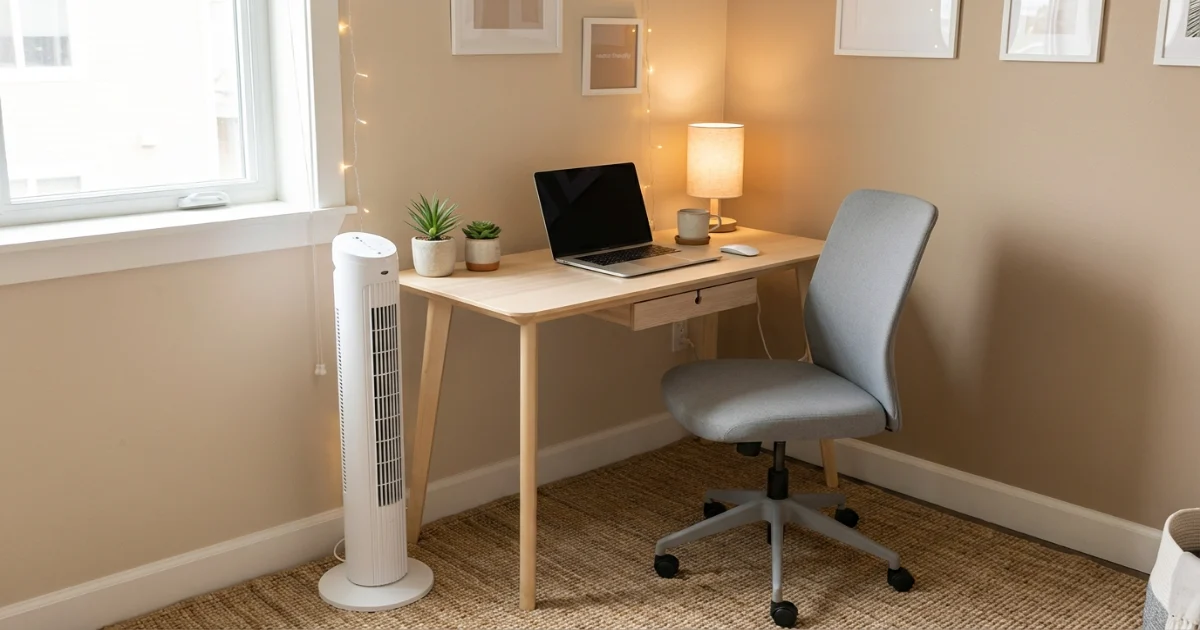
Best Cooling Picks by Room Type
| Room Type | Best Option | Why It Works |
|---|---|---|
| Bedroom | Dreo Tower Fan or Toshiba Portable AC (sleep mode) | Quiet operation is priority #1 for restful sleep. Under 45 dB on sleep mode. |
| Living Room | LG or Whynter Portable AC | Higher BTU handles larger daytime activity zones; window access is usually easier. |
| Studio Apartment | Dual-hose portable AC (10,000–14,000 BTU) | One unit does the whole space. Position centrally for even distribution. |
| Home Office | Dyson TP07 or Dreo Tower Fan | Quiet + purification helps focus. No distracting noise during calls. Pairs well with a renter-friendly home office setup. |
| Kitchen | Compact desk fan or small tower fan | Kitchens need quick air movement during cooking. No venting needed. Easy to tuck away after use. |
Renter-Friendly Tips to Stay Cool Without Damaging Walls or Windows
Renting limits your options — but not as much as most people think. Here’s how to maximize cooling while staying completely damage-free:
- Use foam window insulation tape to seal gaps around your portable AC’s window kit. It improves efficiency without any adhesive damage to the frame.
- Blackout curtains (hung on tension rods — no drilling) can reduce the temperature of a sun-facing room by up to 20°F. A genuine game-changer on west-facing windows.
- Reflective window film is another renter-safe trick. It peels off cleanly and reduces solar heat gain significantly.
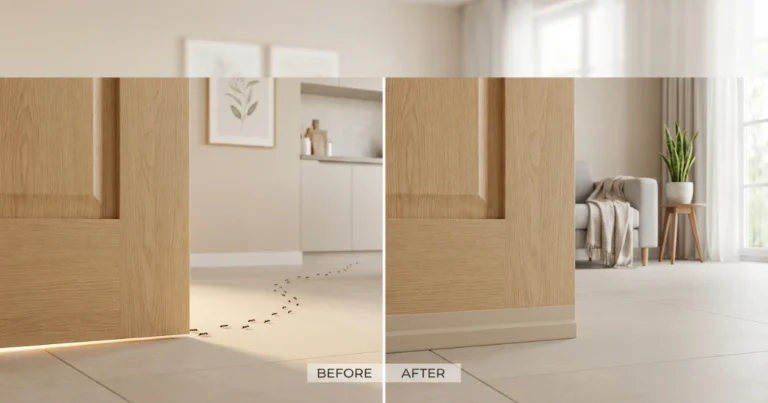
- Use door draft stoppers to keep cool air in. Available in adhesive-free versions.
- Position fans to cross-ventilate: one fan drawing cool air in, one pushing warm air toward an open window. More effective than just blowing air at yourself.
- Try damp towels in front of a fan as an improvised evaporative cooler on especially hot days.
- All of the above work in harmony with no-damage wall decor ideas and hanging art without nails — the renter ethos is always about creative, reversible solutions.
⚠️ Watch Out Never block return air vents on a portable AC with furniture or drapes. It forces the unit to work harder, reduces efficiency, and can cause the compressor to overheat. Keep a 12-inch clearance around the unit at all times.
Styling Tips So Your Cooling Appliances Don’t Ruin Your Decor
This is something nobody talks about, but every design-conscious renter feels. You spend time carefully building your apartment aesthetic — layering textures, hanging art, finding the right throw pillows — and then a chunky white plastic AC box completely torpedoes the vibe.
Here’s how to integrate cooling appliances into your space intentionally:
- Match the unit color to your walls. A white tower fan against white walls is essentially invisible. A dark gray unit looks intentional in a moody, modern space.
- Use it as an anchor, not an afterthought. Place the fan or AC in a corner as a deliberate design element, flanked by a plant and a floor lamp. Suddenly it looks styled.
- Cable management matters. A neatly tucked power cord (use cable clips from the hardware store — removable adhesive ones) makes any appliance look cleaner.
- Go vertical. Tower fans naturally draw the eye up, which makes rooms feel taller — a bonus in low-ceiling apartments.
- If you’re updating your space seasonally, check out our spring kitchen decor ideas and peel-and-stick wallpaper brands for damage-free ways to refresh your backdrop before the heat arrives.
- Pair cooling appliances with adhesive wall art that carries a breezy, airy summer theme — it makes the whole space feel intentionally curated, not just functional.
Common Mistakes to Avoid
- Buying too many BTUs. Bigger isn’t always better. An oversized AC cools the air quickly but doesn’t run long enough to dehumidify properly, leaving you with cold, clammy air.
- Ignoring the hose length. Most portable AC hoses are 5–6 feet. If your window is far from where you want to place the unit, you’ll be moving furniture or leaving the unit in an inconvenient spot.
- Underestimating heat sources. A south-facing apartment with large windows, thin walls, or a top-floor location needs more BTUs than the room size alone suggests. Add 10–15% to your BTU calculation if any of these apply.
- Putting a fan in a sealed room and calling it air conditioning. A fan doesn’t cool air — it moves it. In a sealed, hot room, you’re just moving hot air faster. Open a window or door.
- Choosing purely on price. The cheapest portable ACs tend to be noisier, less efficient, and more likely to require manual water draining every few days. Spend slightly more for auto-evaporation and a decent CEER rating.
- Forgetting about the exhaust hose gap. Seal the gap around the hose in the window kit with foam tape. Without it, warm outdoor air seeps back in and forces your AC to work harder.
Final Verdict
Best overall for most small apartments: The LG LP0821GSSM dual inverter portable AC hits the sweet spot of quiet operation, efficiency, and design. If you have a window and a room over 250 sq ft, this is where most renters should start.
Best for bedrooms specifically: The Dreo DR-HTF008 tower fan is near-silent, beautifully slim, and genuinely affordable. For mild climates or anyone sensitive to noise, it’s unbeatable value.
Best for studios and open-plan spaces: The Whynter ARC-14S has the muscle to cool a larger open space effectively. Yes, it’s bigger — but in a studio, one good unit beats two mediocre ones.
Best for design-forward apartments: The Dyson TP07 or BALMUDA GreenFan if you want something that genuinely adds to your decor rather than competing with it. They’re both premium investments that justify the price through daily use.
No window? No problem — go with the Honeywell CO30XE evaporative cooler in a dry climate, or a high-quality tower fan with strong oscillation elsewhere. You’ll be more comfortable than you expect.
People Also Ask: Portable ACs & Fans for Small Apartments
Are portable air conditioners worth it for apartments?
Yes — especially for apartments without central air or built-in window AC units. Modern portable ACs are more efficient and quieter than they were five years ago. For renters, they offer genuine cooling without lease-violating installation. If your apartment regularly hits 80°F+ indoors in summer, a portable AC pays for itself quickly in comfort and productivity.
Do portable air conditioners need a window?
Standard portable ACs require a window to exhaust hot air through a venting hose. However, there are alternatives: evaporative coolers (swamp coolers) don’t need a window and genuinely cool air in low-humidity environments. High-powered tower fans and bladeless fans also work without a window, though they move air rather than cooling it. If you have no window access at all, an evaporative cooler or quality tower fan is your best bet.
What is the best fan for a small apartment bedroom?
For bedrooms, the Dreo DR-HTF008 tower fan is our top pick in 2026. It runs at just 25 dB on sleep mode — quieter than a whisper — and its slim 11-inch footprint takes up almost no floor space. For those with a higher budget, the Dyson TP07 adds air purification and an even more refined experience. In either case, prioritize noise level over airflow volume for bedroom use.
Are tower fans better than box fans for apartments?
Generally, yes. Tower fans offer a much smaller footprint, more consistent airflow distribution, quieter operation, and cleaner aesthetics — all of which matter in a small apartment. Box fans move a higher volume of air but are louder, bulkier, and harder to store. The only real advantage of a box fan is price and raw airflow if you’re trying to ventilate a space quickly with a window setup.
How can renters cool an apartment without central AC?
Renters have several good options: (1) A portable AC with a window venting kit — renter-safe, no installation. (2) A high-quality tower fan for mild climates. (3) An evaporative cooler if you’re in a dry climate with no window access. (4) Layering passive strategies like blackout curtains, reflective window film, and cross-ventilation can reduce indoor temps by 10–15°F before you even turn on a machine. Combining a portable AC with good passive cooling is the most efficient overall approach.
Do portable air conditioners use a lot of electricity?
More than fans, but less than you might fear. An 8,000 BTU portable AC draws roughly 900–1,200 watts per hour. Running it 8 hours a day at average US electricity rates (~$0.16/kWh) costs about $1.15–$1.54 per day. Over a three-month summer, that’s approximately $100–$140. Energy Star certified models and inverter ACs (like the LG LP0821GSSM) run more efficiently by cycling the compressor, potentially cutting those numbers by 15–25%.
Can I use a portable AC in a studio apartment?
Absolutely — studios are actually ideal for portable ACs because one unit can cover the entire living space. Choose a BTU rating that matches your studio’s square footage (10,000–14,000 BTU for most studios up to 500 sq ft). A dual-hose portable AC is particularly well-suited to studios because it maintains air pressure better in an open-plan space. Position it near — but not directly blocking — your main seating area for the best airflow distribution.
What is quieter: a fan or a portable AC?
Fans are almost always quieter. The quietest tower fans run at 20–30 dB on low — barely audible. Portable ACs typically range from 50–60 dB on high, with quieter models hitting around 44–52 dB on sleep mode. For context, 50 dB is roughly the level of a quiet office or rainfall. If silence is critical — especially for light sleepers or video call-heavy home offices — a tower fan wins on noise. Inverter-based portable ACs are the closest the AC category gets to fan-level quiet.
Will a portable AC window kit damage my apartment windows?
No — modern portable AC window kits are specifically designed to be renter-friendly. They use adjustable foam-sealed panels that slide or wedge into the window frame without drilling, screws, or adhesive. When removed, they leave no marks on the frame or sill. Seal any remaining gaps with removable foam weather stripping for better efficiency. Always check that your window type (sliding, double-hung, or casement) is compatible with the kit that comes with your unit before purchasing.
What size portable AC do I need for a 300 sq ft apartment?
For a 300 sq ft apartment or room, an 8,000–10,000 BTU portable AC is the right range. Go toward the higher end (10,000 BTU) if the room is on an upper floor, has south- or west-facing windows, or has poor insulation. Going significantly over 10,000 BTU for this size is counterproductive — the unit will cycle on and off too quickly, reducing its ability to dehumidify the air and resulting in that cold-but-clammy feeling.
Love Your Small Space This Summer
Cooling your apartment is just one part of making it a place you genuinely love coming home to. From damage-free wall art to peel-and-stick wallpaper, smart lighting, and renter-friendly furniture ideas — NoDamageDecor.com has everything you need to make your rented space feel like yours.
Explore Renter-Friendly Decor Ideas →Conclusion
Staying cool in a small apartment in 2026 doesn’t have to mean wrestling with clunky equipment, battling your landlord, or overpaying on your electricity bill. The right portable AC or fan — matched to your space, your climate, and your lifestyle — makes a dramatic difference in daily comfort.
If you’re in a hot, humid climate and your apartment regularly reaches 80°F+ indoors, don’t skip the portable AC. The LG LP0821GSSM or the Whynter ARC-14S will genuinely change your summer. If you’re in a milder zone, or your priority is silence and subtlety, a quality tower fan like the Dreo or Dyson TP07 is all you need and will look great doing it.
Either way, keep in mind that the best cooling setup is one that works with your apartment, not against it. Damage-free, reversible, and thoughtfully styled — exactly the kind of renter-smart thinking that applies equally to your furniture, your wall decor, and your peel-and-stick decor choices.
Stay cool. Stay stylish. And remember — a great-looking apartment doesn’t have to cost your security deposit.