Pot Lid Storage Without Drilling Into Cabinets
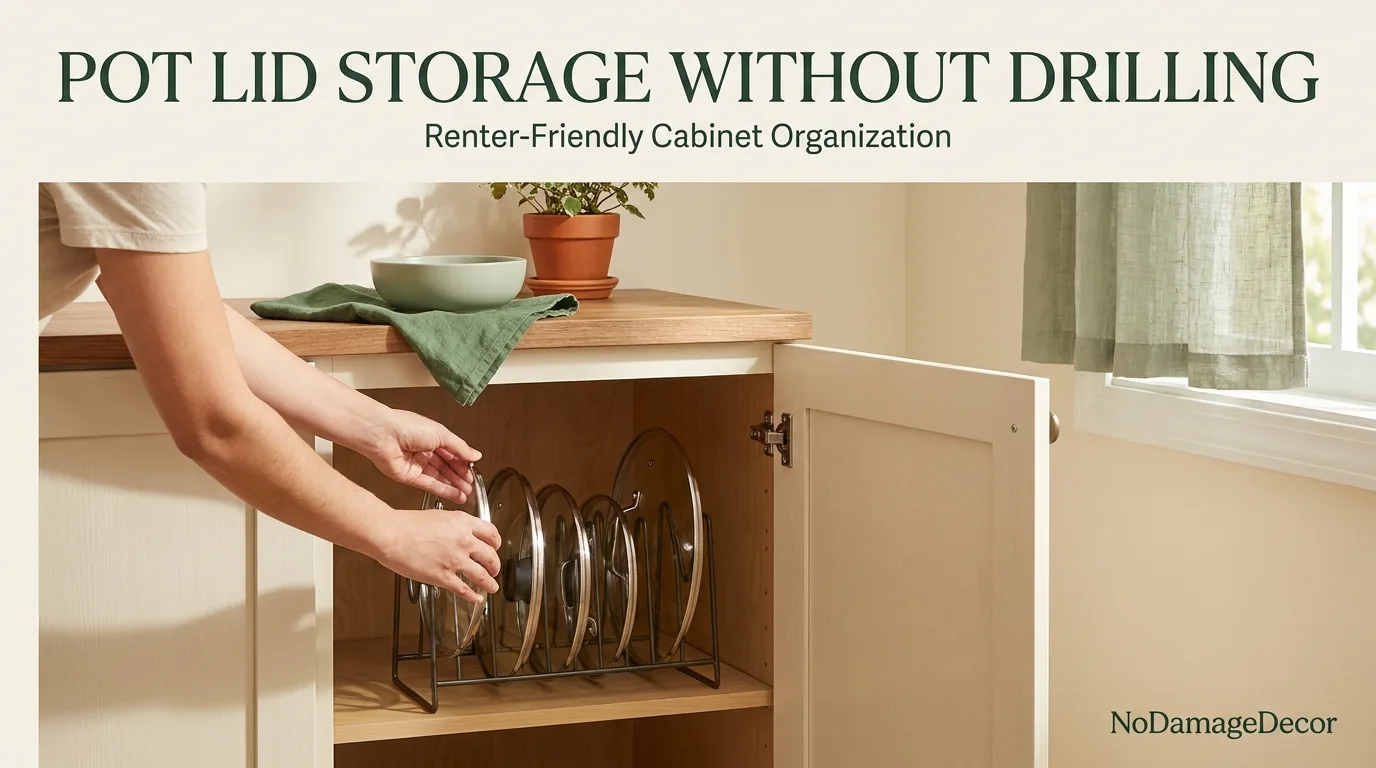
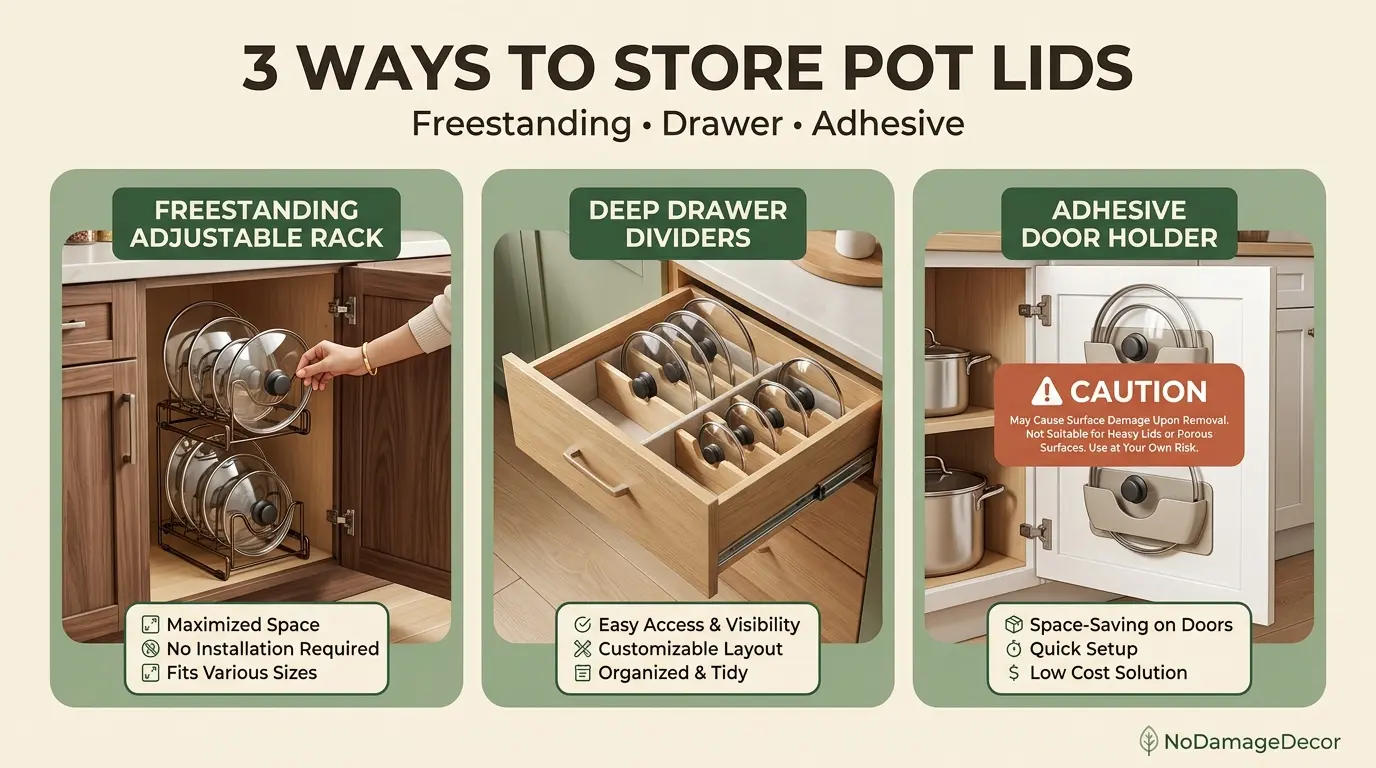
Pot lid storage without drilling is usually easiest when you keep the organizer freestanding inside the cabinet or drawer instead of attaching hardware to cabinet doors or side panels.
At a Glance
Pot Lid Storage Without Drilling: Best Methods for Renters
Pot lids are awkward because they are flat enough to stack but unstable enough to slide, roll, and trap smaller pieces underneath larger ones. The renter problem is not simply finding a rack. It is finding a system that keeps lids visible without turning a landlord-owned cabinet into a permanent installation project.
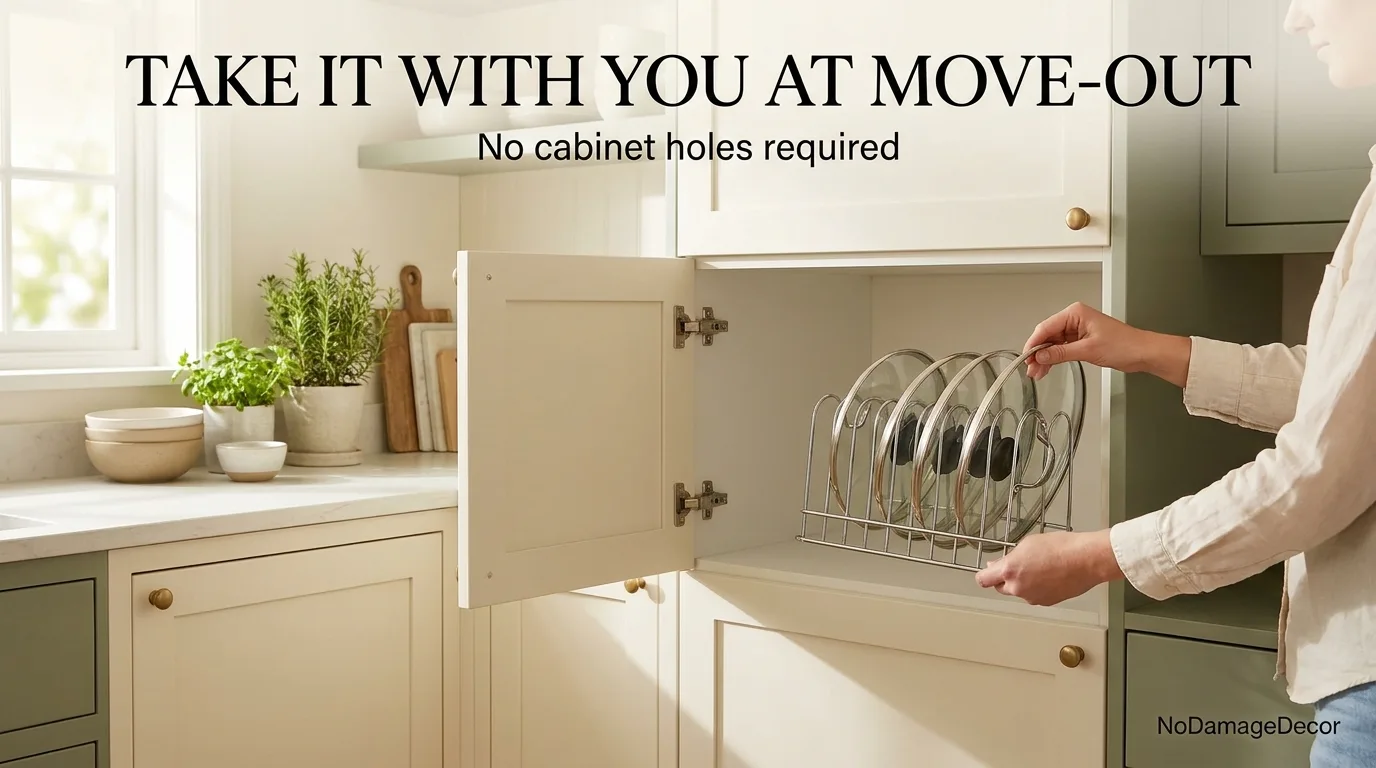
For most rentals, the cleanest answer is vertical storage that sits on the cabinet floor or in a drawer. The organizer carries the lid weight while the cabinet only acts as the surrounding enclosure. Nothing has to be screwed into the door, side wall, shelf, or face frame.
| Method | Best For | Cabinet Contact | Main Trade-Off |
|---|---|---|---|
| Freestanding adjustable lid rack | Lower cabinets, pantries, wide shelves | Only base or non-slip feet touch shelf | Uses some shelf footprint |
| Expandable pan-and-lid rack | Mixed cookware and lids | Freestanding base | Needs more horizontal cabinet width |
| Deep-drawer dividers | Kitchens with deep pot drawers | Divider rests or tensions inside drawer | Drawer height must clear lid handles |
| Countertop lid rack | Frequently used lids near the stove | No cabinet attachment | Uses visible counter space |
| Adhesive cabinet-door holders | Very tight cabinets with suitable smooth door surface | Direct adhesive contact | Higher finish/removal risk |
Measure the Cabinet Before Choosing a Lid Organizer
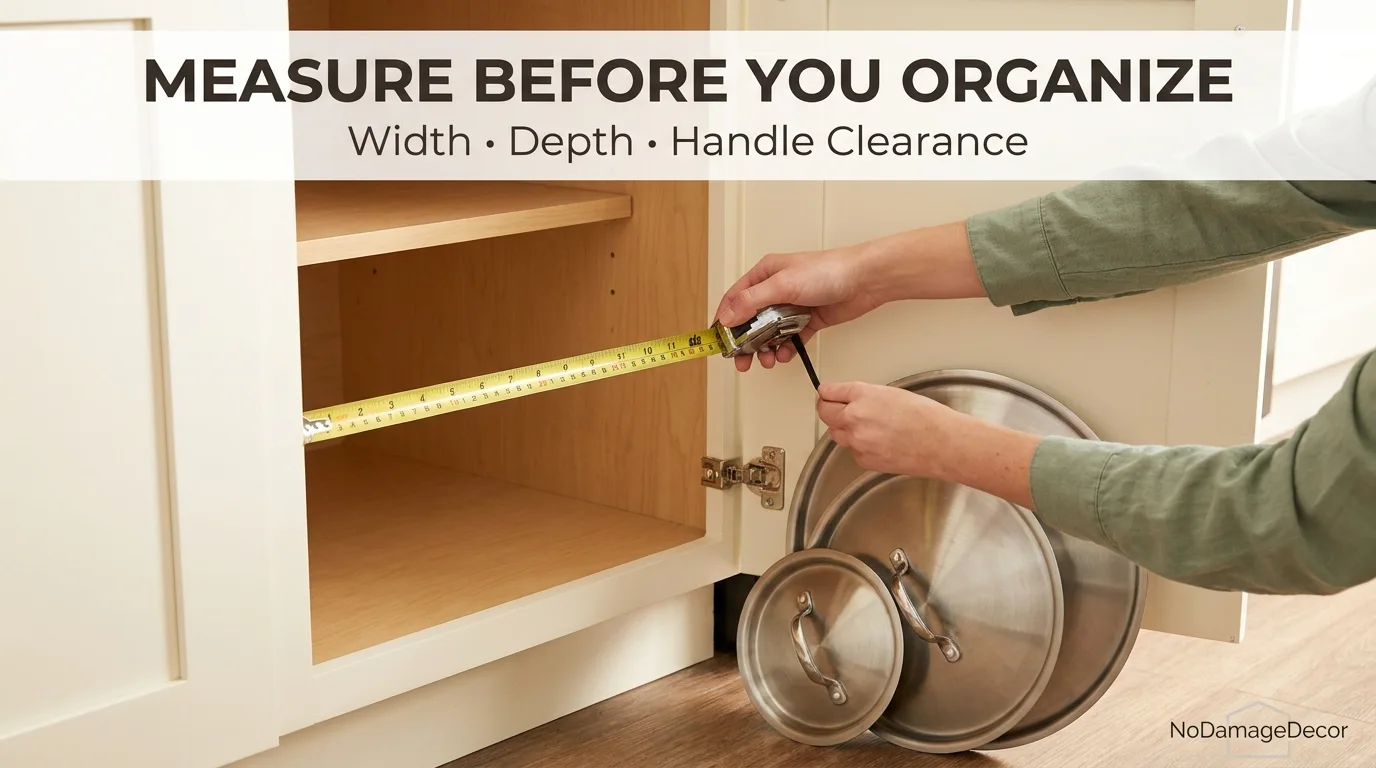
Cabinet organizers often fail for a simple reason: renters measure the opening but not the usable interior. Hinges, door frames, plumbing, shelf lips, and cookware handles can reduce the space that actually matters.
Measure the cabinet width where the organizer will sit, not just the face opening. Check depth from the front edge to the back panel. Then measure height from the shelf surface to the shelf above. If you plan to store large glass lids upright, add the knob or loop handle to the height you need.
Door clearance matters too. A lid can fit comfortably inside the cabinet and still block the door if its handle projects forward. In framed cabinets, the face frame may create a narrower exit path than the interior width suggests. Test your largest lid by holding it upright where the rack will sit before you buy an organizer.
Choose a compact lid rack when…
You mainly have lids, your pans already stack well, and the cabinet is narrow. A dedicated lid holder wastes less space than a large pan-and-lid system.
Choose an expandable rack when…
You want to organize pans, cutting boards, platters, and lids together and have enough cabinet width for a larger adjustable base.
Pot Lid Handles Change the Spacing You Need
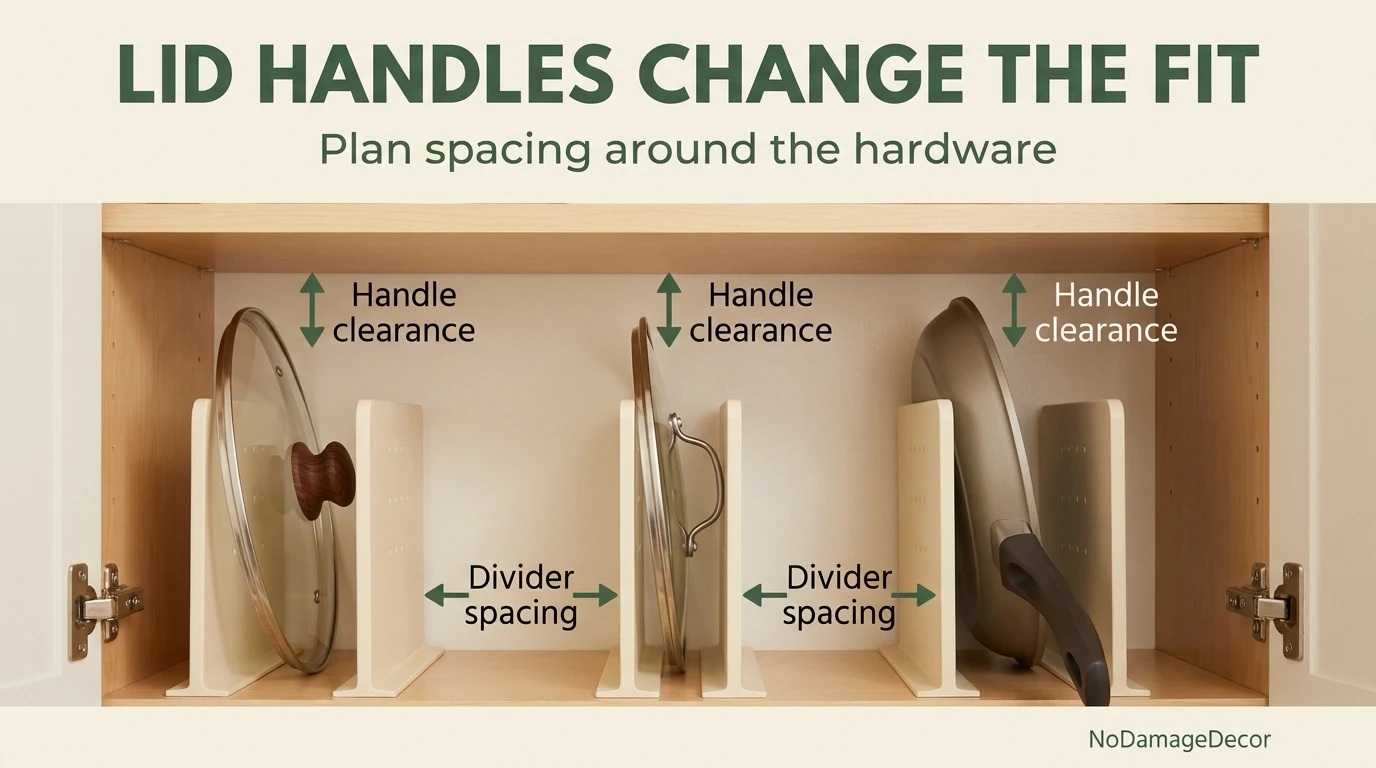
Two lids with the same diameter can require different storage spacing. A low round knob may fit easily between close dividers, while a loop handle or tall metal handle can collide with the lid next to it. Some glass lids also have thick rim hardware that needs a wider slot.
Adjustable dividers are useful because you can give a bulky lid more room and keep thinner lids closer together. The goal is not maximum compression. Lids should stay upright without being wedged so tightly that you have to pull hard against neighboring glass or metal.
Place the most frequently used lids where you can remove them in one motion. If a large lid must be tilted under a shelf every time, move it to the outside divider or another cabinet. A storage system that looks neat but requires wrestling with cookware will not stay organized for long.
Why Cabinet-Door Adhesive Storage Is a Higher-Risk Renter Choice
Mounting lids on the back of a cabinet door can look efficient because it uses otherwise empty vertical space. But for renters, the cabinet finish becomes part of the mounting system. The adhesive is no longer touching a replaceable organizer—it is bonded to paint, veneer, laminate, thermofoil, clear coat, or another finish owned by the property.
Cabinet doors also move. Every opening and closing cycle creates vibration. A glass lid adds concentrated weight, and a lid can shift if the door closes quickly. Even when a product claims removable adhesive, the finish underneath has to remain stronger than the adhesive during both use and removal.
That is why a cabinet-door solution should not be the default if a freestanding rack will solve the same problem. Use adhesive storage only when the exact product instructions support the surface, the lid weight and shape are within the product’s stated limits, and the finish is sound enough to test.
Lower-risk surfaces
A clean, smooth, hard, well-bonded surface can be easier for approved removable adhesive than a weak painted or textured finish. Still follow the exact product instructions.
Use another method when…
The cabinet finish is peeling, soft, freshly refinished, unknown, textured, damaged, or expensive enough that even a small finish pull would be difficult to repair.
How to Organize Pot Lids Without Drilling
Pull every lid out first
Match lids to the cookware you still use. Remove duplicates, damaged lids, or lids for pans you no longer own before buying storage around them.
Sort by diameter and handle type
Group small lids, large lids, tall knob handles, and loop handles. This shows how much divider spacing you actually need.
Measure the cabinet interior
Check width, depth, usable height, shelf lip, hinge intrusion, and the narrowest part of the opening.
Place the organizer on a flat stable surface
A freestanding rack works best when its base is fully supported. Do not balance it partly on a shelf lip or uneven liner.
Set divider spacing around the lid handles
Give glass lids enough space that rims do not scrape together. Keep each lid upright without forcing it into the slot.
Put frequently used lids near the front
Daily-use lids should come out without removing three other pieces first. Rarely used oversized lids can go farther back.
Test the cabinet door and nearby cookware
Close the door slowly. Make sure handles do not hit the door, shelf above, hinges, or stacked pans.
For more no-drill kitchen organization ideas, see no-drill kitchen upgrades and our guide to a peel and stick backsplash if you are improving the same kitchen without permanent construction.
Verified Pot Lid Organizers That Need No Drilling
These options sit inside a cabinet or on a countertop. Neither requires screws into cabinet panels, which makes them easier to reverse when you move.
As an Amazon Associate I earn from qualifying purchases.
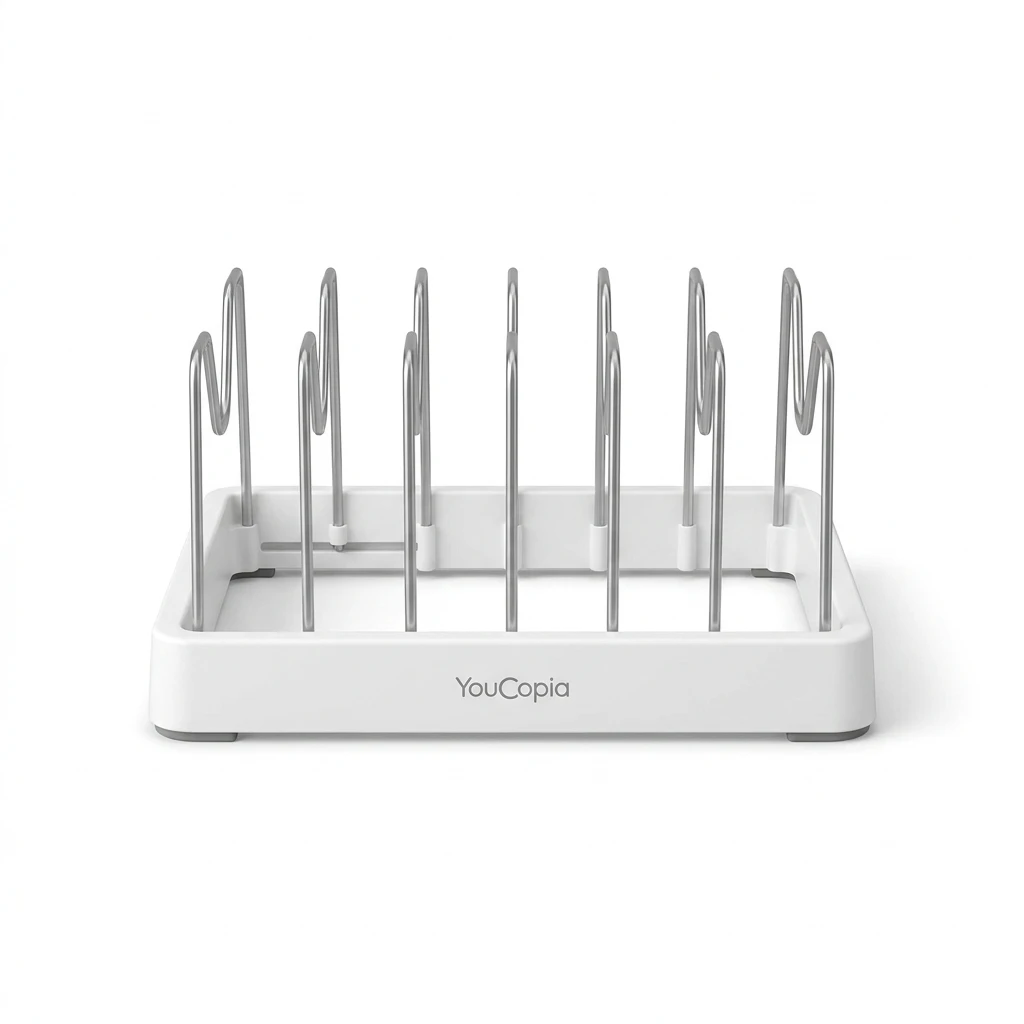
YouCopia StoreMore Adjustable Pot Lid Organizer, Standard, White
Best for: Renters who want a compact dedicated lid rack inside a lower cabinet or pantry.
YouCopia’s current StoreMore lid-holder design uses a freestanding base with seven adjustable dividers. The manufacturer states that the dividers are coated steel, the base has non-slip feet, and no tools, mounting, or installation are required. Current manufacturer dimensions are approximately 7.3 inches deep, 11.5 inches wide, and 4.9 inches high with dividers installed.
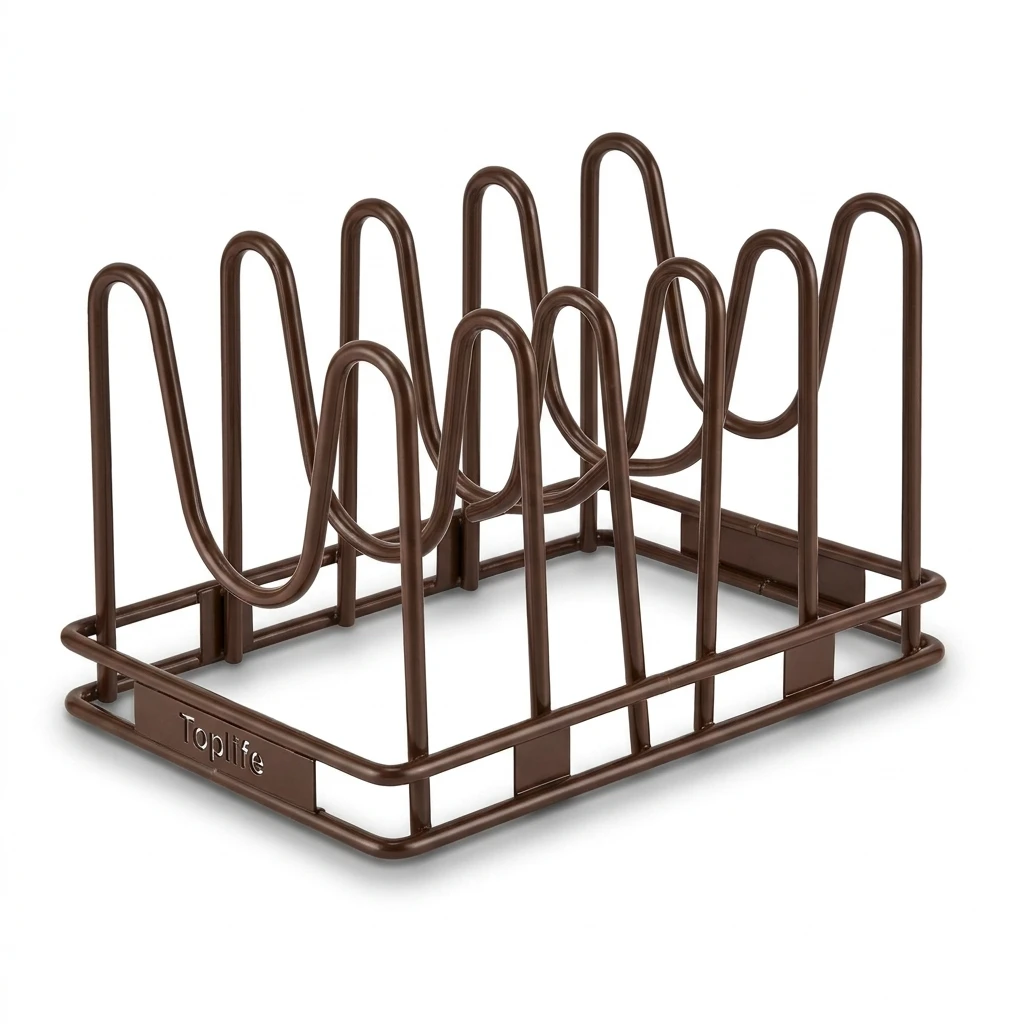
Toplife Pot Lids Organizer Rack for Cabinet and Countertop, Brown
Best for: Renters who prefer an open metal rack for lids, bakeware, boards, or shallow pans.
Current product information identifies this organizer as a coated metal rack with seven adjustable compartments. It can be used inside a cabinet or on a countertop and does not require drilling into the cabinet.
Small-Kitchen Pot Lid Storage: Use the Right Zone
In a small rental kitchen, the best lid-storage location is often more important than the organizer itself. Putting every lid in the deepest corner of a lower cabinet may save visual clutter but can make daily cooking frustrating.
If the cabinet below the stove is wide enough, store pans and lids in the same zone so you can grab both without crossing the kitchen. In a narrow galley layout, a compact dedicated lid rack can sit beside stacked pans. If you have deep drawers, upright lid dividers can work well because the drawer brings the entire group toward you.
Countertop storage can be reasonable when cabinet space is extremely limited and you use the lids every day. Keep the rack away from burner heat, splatter zones, and the sink edge. A clean countertop rack is often less damaging than trying to attach heavy lids to a weak cabinet finish.
Also check what the organizer is resting on. A freestanding rack should sit flat on the cabinet shelf or drawer base, with its non-slip feet fully supported. Thick, wrinkled, or loose shelf liner can make a narrow rack rock when you pull out a heavy glass lid. If the cabinet already has a removable liner, flatten it first rather than taping the organizer to the cabinet. The goal is to let the organizer provide the stability without turning a portable system into a bonded installation.
For very small kitchens, split storage by frequency instead of forcing every lid into one rack. Keep the two or three daily-use lids closest to their matching pans, then store oversized stockpot lids or rarely used pieces farther back or in a pantry. This reduces the number of dividers you need in the prime cooking zone and makes a compact organizer more useful without adding hardware to the cabinetry.
If you are reorganizing an entire first kitchen, the first apartment decorating checklist and make your rental feel like home guide can help prioritize upgrades that move with you.
Common Pot Lid Storage Mistakes
Buying a rack before measuring
A rack can fit the shelf width but still be too tall once lid handles are added.
Spacing dividers too tightly
Glass rims and metal edges can scrape when lids have to be forced in or pulled out at an angle.
Storing the heaviest lids on adhesive hooks
The cabinet finish and adhesive become part of the load path. A freestanding base is usually easier to trust and reverse.
Ignoring the cabinet door swing
A lid handle can project forward enough to hit the door even when the rack itself fits perfectly.
Letting lids lean against fragile cabinet finishes
Repeated movement can scuff paint, veneer, or laminate. Adjust the dividers so lids stay supported by the organizer.
Using organizers as permanent modifications
Do not screw a rack into a rental cabinet unless the lease or landlord clearly allows it. A portable rack usually solves the same storage problem.
For more renter mistakes that can create avoidable repair work, see apartment decor mistakes that cost your deposit.
Sources & Renter-Safety Note
Product specifications for the YouCopia StoreMore Adjustable Lid Holder were checked against the current official YouCopia product page, which states that the rack includes seven adjustable dividers, uses coated steel wires, has non-slip feet, requires no tools or mounting, and measures about 7.3 inches deep by 11.5 inches wide by 4.9 inches high with dividers installed. The Toplife product name, ASIN, adjustable-divider design, and cabinet/countertop use were cross-checked against current retailer listings. Cabinet dimensions, finishes, lease rules, and organizer designs vary, so measure your actual cabinet and follow the current product instructions before use.
YouCopia StoreMore Adjustable Lid Holder — official product details
Frequently Asked Questions
What is the best pot lid storage without drilling for renters?
A freestanding adjustable lid rack is usually the most renter-friendly starting point because it organizes lids vertically without screws or adhesive on the cabinet.
Can I store pot lids on the back of a cabinet door without drilling?
Yes, some products use removable adhesive, but cabinet finishes vary. A freestanding rack is lower-contact. If you use adhesive, verify the exact product’s surface guidance and test the finish first.
Will a freestanding lid rack scratch glass lids?
Choose a rack with coated or smooth dividers and give each lid enough space. Do not force glass rims against neighboring lids or bare sharp metal.
Can I store pans and lids in the same organizer?
Yes. Expandable pan-and-lid racks are designed for mixed cookware when cabinet width allows. A dedicated compact lid rack is usually better if you only need lid storage.
Should pot lids be stored vertically or stacked?
Vertical storage usually makes individual lids easier to see and remove without lifting an entire stack. The best setup depends on your cabinet height, lid handles, and available shelf width.
What should I measure before buying a pot lid organizer?
Measure usable cabinet width, depth, shelf height, door opening, hinge clearance, and the height of your largest lid including its handle.
How do I remove the organizer at move-out?
A freestanding rack simply lifts out. Clean the shelf beneath it and photograph the cabinet if you are documenting move-out condition. Adhesive systems should be removed only with the manufacturer’s exact method.
Renter-Safety Verdict
Best overall choice: a freestanding adjustable lid rack that sits on the cabinet shelf and does not attach to the cabinetry.
Best for mixed cookware: an expandable pan-and-lid organizer when you have enough internal cabinet width.
Use more caution with: adhesive cabinet-door lid holders, especially on painted, veneered, thermofoil, laminate, or unknown finishes.
Avoid: drilling into rental cabinets without written approval, generic adhesive-hook improvisations for heavy glass lids, and organizers that force lids against the cabinet door.
The most renter-friendly solution is the one that controls the lids without making the cabinet itself part of the installation.
Keep the Upgrades Portable and No-Drill
Build a more functional rental kitchen with storage improvements that can move with you instead of becoming permanent cabinet work.
See No-Drill Kitchen Upgrades