No Damage Wall Decor Ideas for Renters: 15 Renter-Friendly Options
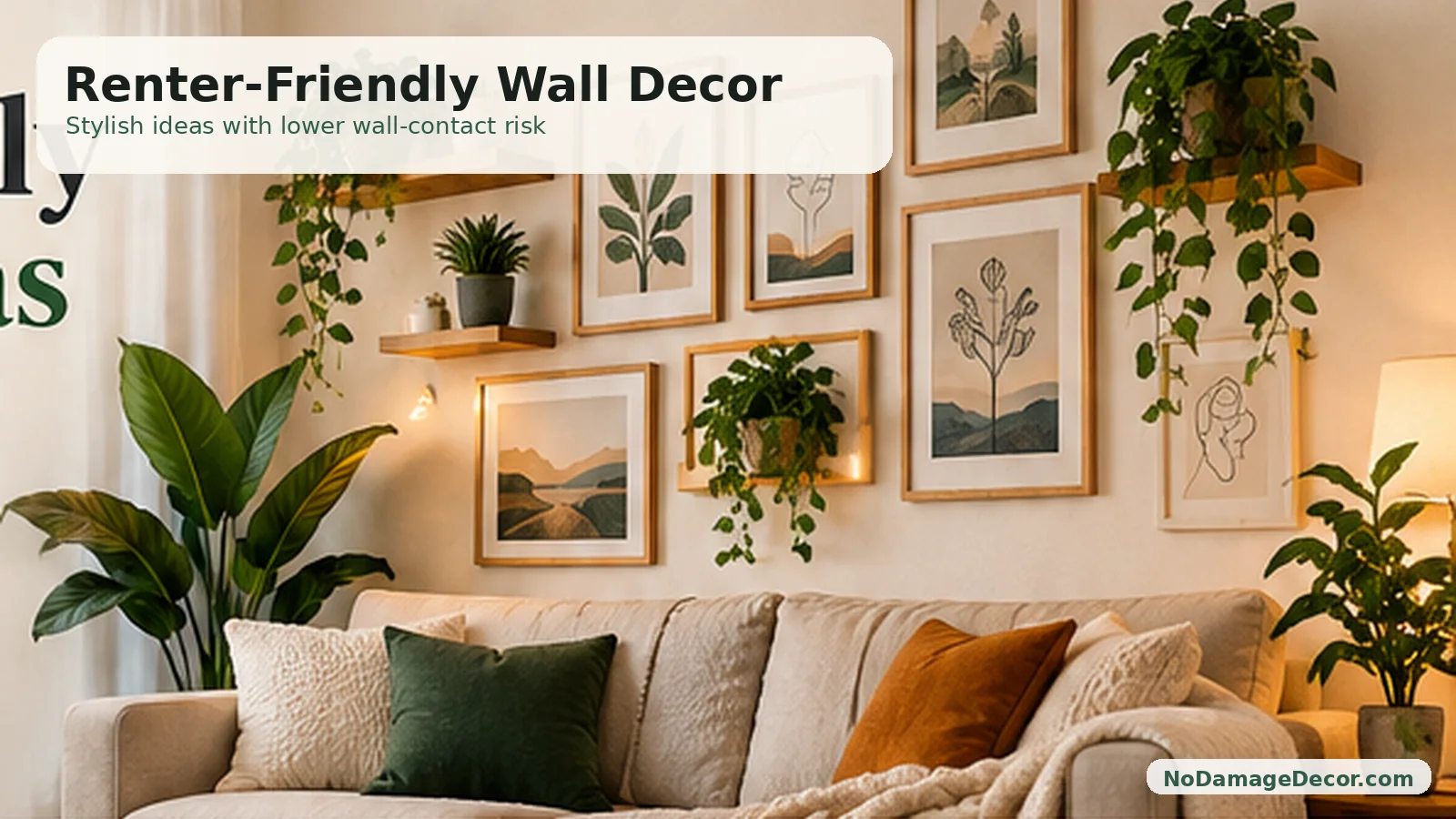
No damage wall decor ideas work best when you match the decorating method to the wall finish, the item’s weight, the manufacturer’s instructions and your lease. The safest-looking option is not always the lowest-risk one: a light frame on the correct picture strips may be more sensible than a “removable” adhesive shelf loaded with décor.
Quick Answer
Start with methods that avoid permanent holes and keep the load modest: manufacturer-rated picture strips for compatible smooth walls, removable wallpaper on approved painted surfaces, leaning or freestanding art, tension-based décor and lightweight lighting on purpose-made clips. Avoid assuming any adhesive is universally paint-safe, and do not use adhesive-only mounting for valuable, fragile or injury-risk items unless the exact product explicitly supports the use.
At a Glance
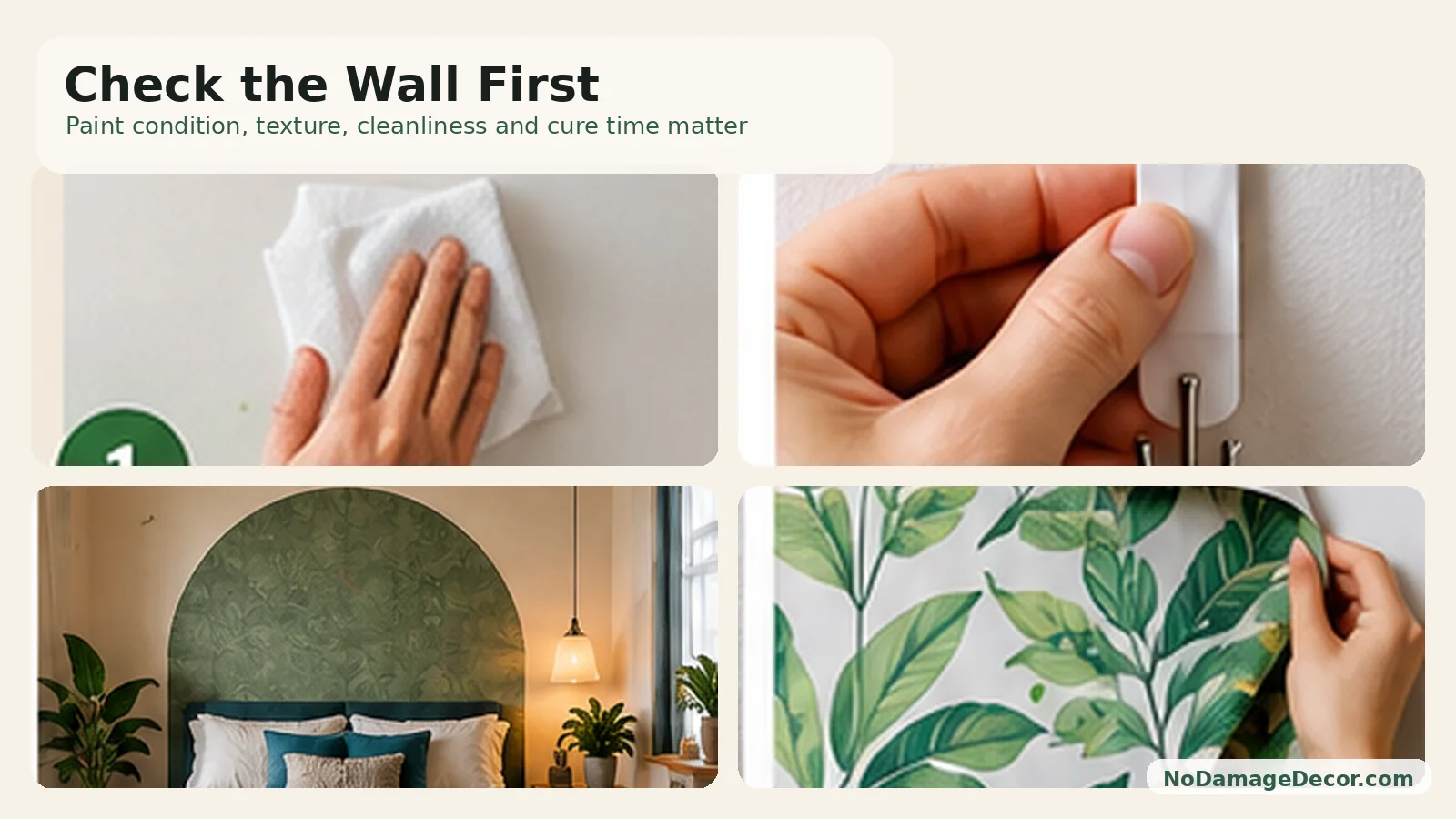
Check the Wall Before Choosing the Decor Method
The original version of this guide treated “no damage” almost like a product category. In a rental, it is better to think in terms of lower-risk methods for a specific surface. Paint quality, wall texture, humidity, temperature, the item’s weight and the way you remove an adhesive all affect the result.
15 No Damage Wall Decor Ideas for Apartments
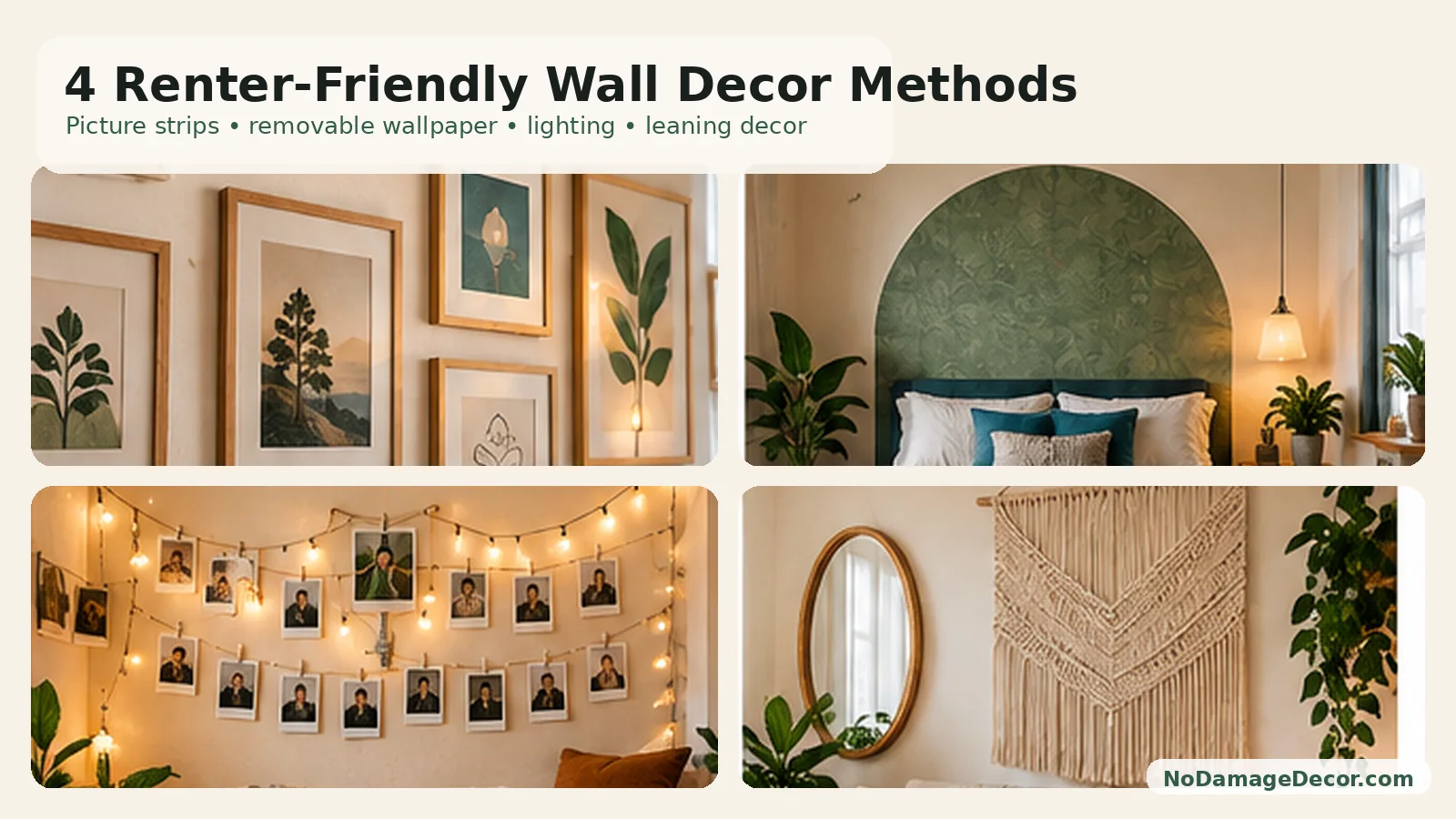
Use picture hanging strips for compatible lightweight frames
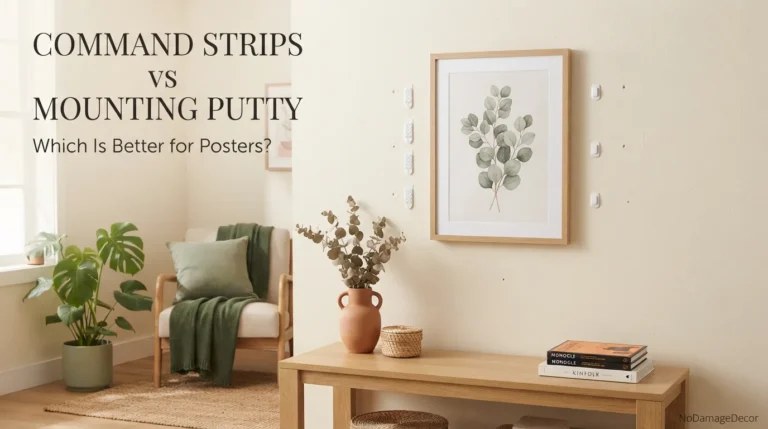
For framed prints, use a picture-hanging product that is rated for the frame’s weight, size and wall surface. Follow the exact pair count on the package instead of adding random extra strips. For a more detailed setup, see how to hang art without nails.
Use small removable hooks for lightweight decorative items
Small hooks can work for light garlands, keys, lightweight seasonal décor or purpose-approved accessories. They are not a substitute for picture strips when the manufacturer says frames should use another product.
Lean framed art on a console, dresser or mantel
Leaning art removes the wall attachment question entirely. Layer one larger print behind a smaller frame and keep the arrangement stable enough that normal bumps will not send the frames sliding.
Use a floor easel for a statement print
A slim floor easel creates a gallery-like focal point without adhesive or holes. This works especially well in a living room corner where you have wall height but do not want to commit to mounting hardware.
Choose a freestanding mirror designed for floor use
Instead of hanging a heavy mirror from adhesive, choose a stable floor mirror or stand designed to be freestanding. Large leaning mirrors can tip, so follow the mirror manufacturer’s anti-tip guidance and do not improvise around a required safety anchor.
Create one peel-and-stick wallpaper accent area
Removable wallpaper can deliver more visual change than a dozen small accessories, but use it only on surfaces allowed by the exact brand. Tempaper currently recommends smooth walls in good condition with compatible cured paint, while RoomMates says its peel-and-stick wallpaper is for smooth, flat, clean, dry painted surfaces.
Use wall decals on a small, testable zone
Decals work well for a home office, kids’ room or entryway where a full wallpaper wall feels too committed. Test the actual paint first and keep the original removal instructions.
Try washi tape for very lightweight visual accents
Washi tape can create borders, faux frames and simple geometry, but paint finishes vary. Test a small hidden area before building a large design, and remove slowly rather than assuming every tape will release identically.
Build a photo garland with purpose-made decorating clips
Use lightweight paper photos and a clip system rated for string lights or small décor. Avoid turning a delicate clip into support for a heavy wood frame or metal sign.
Use removable clips for string lights
Purpose-made light clips can create a softer wall feature than raw adhesive LED tape pressed directly onto paint. Keep cords relaxed and away from heat, doors and snag points. More options are in our renter-friendly lighting ideas.
Use a tension rod for fabric in an alcove or window zone
A tension rod can hold a lightweight textile, café curtain or decorative fabric inside a suitable recess without holes. Check the rod’s span and load limit and make sure pressure pads will not mark a weak finish.
Mount fabric to lightweight panels, then lean the panels
Instead of hanging a heavy tapestry directly, wrap fabric around lightweight panels and lean them on a console or floor. You get color and texture without relying on multiple wall hooks.
Use a manufacturer-rated no-drill picture ledge
Some adhesive ledges are made for lightweight display items. Use the ledge only within its stated load and surface rules, and do not place fragile or valuable objects where a release could cause injury or breakage. For more shelf-specific options, see floating shelves without drilling.
Bring greenery up with furniture, not adhesive planters
Use bookcases, plant stands, ladder shelves or tall floor plants to bring greenery into the wall zone. This gives the visual effect of “living wall” décor without hanging a water-filled planter from adhesive.
Use projection, lighting or a digital frame for changeable art
A small projector, smart display or digital frame on furniture can change the visual wall experience without attaching anything to paint. This is useful for renters who like to rotate art frequently.
For very small rooms, combine only two or three of these ideas so the wall does not become visually crowded. Our studio apartment decor ideas guide goes deeper on scale and small-space balance.
How to Use Removable Hooks and Picture Strips More Safely
Current Command instructions are much more specific than the old “clean, press and hang” advice. For many indoor products, 3M says to clean the wall with rubbing alcohol rather than household spray cleaner, wait seven days after painting, press as directed and wait the listed time before loading the strip. Product instructions can vary, so the package for the exact item still takes priority.
Match the product to the object
Picture hanging strips are designed for frames and flat-backed décor. Hooks are designed for compatible hanging items. Use the product type the manufacturer intends instead of forcing one adhesive format to solve every wall problem.
Valuable items and over-bed mounting
Current 3M instructions warn against using many Command products for valuable or irreplaceable items, over beds, or on wallpaper. Those warnings matter more than a social-media hack.
Do not assume “more strips” automatically creates unlimited capacity. The weight rating belongs to a specific product, size, quantity, frame dimension and installation pattern. For example, 3M currently lists its Large Picture Hanging Strips at up to 15 lb when four pairs are used as directed for a qualifying frame. Other strip sizes have different limits.
Removable Wallpaper and Decals: High Impact, Higher Surface Commitment
Peel-and-stick wallpaper can be an excellent renter tool when the wall matches the brand’s requirements. Tempaper currently recommends smooth surfaces in good condition that are primed and painted with eggshell, satin or semi-gloss finishes, and says newly painted surfaces should cure for at least four weeks before application. RoomMates similarly says its peel-and-stick wallpaper is intended for smooth, flat, clean, dry painted surfaces and should not be applied to textured walls.
That means the safest workflow is not “buy removable wallpaper and trust the label.” Order a sample when possible, test the actual wall, and keep the product information so you know how the manufacturer expects it to come down later. If you are planning a full accent wall, see our best removable wallpaper for renters guide.
| Wall condition | Better renter decision | Why |
|---|---|---|
| Smooth, sound, fully cured paint | Potential candidate after product check | Provides the most predictable contact and removal baseline. |
| Pronounced texture | Usually choose another method | Many removable wallpaper brands require smooth walls. |
| Fresh paint | Wait for the brand’s cure period | Tempaper currently states a minimum four-week cure for newly painted surfaces. |
| Peeling or chalky paint | Avoid adhesive covering | The paint can become the weak layer during removal. |
| Unknown specialty coating | Test or choose freestanding décor | Adhesion and removal can be unpredictable. |
Heavy Mirrors, Shelves and Hanging Plants Need a Different Standard
The old article encouraged heavy mirrors, planters and shelves too casually. Those items can injure someone or damage flooring if a mount releases. “No nails” should not override the object manufacturer’s safety instructions.
Heavy mirror
Use a stable freestanding mirror designed for floor use, or install the manufacturer-required anti-tip restraint with landlord approval. Do not rely on generic adhesive strips for a heavy or irreplaceable mirror unless the exact product explicitly supports that mirror and setup.
Loaded shelf
Use a verified no-drill shelf only within its stated surface and weight limit. Keep fragile items off adhesive shelves where a release could cause breakage.
Hanging planter
Water adds weight and spills create another failure mode. Prefer a plant stand, bookcase or floor planter unless the hanging system is specifically rated for the full wet weight.
For renters, the cleanest alternative is often to move the décor from the wall onto furniture. A console, narrow bookcase, ladder shelf or floor stand can provide the same visual height without asking the paint layer to carry the load.
Two Real Products That Fit This Guide
These products are included for specific lightweight hanging jobs. Their Amazon ASINs were cross-checked against current indexed listings, and the usage guidance below comes from current 3M documentation. No price, rating or availability claim is included.
Product cards below use verified names and ASINs. Use the live Amazon listing for the current exact product photo rather than an AI-generated substitute.
Command 15 lb Large Picture Hanging Strips, 14 Pairs (28 Strips), White
Current Amazon-indexed records identify ASIN B073XR4X72 as the 14-pair Large Picture Hanging Strips package. 3M’s current Large-strip guidance says four pairs can support a qualifying frame up to 15 lb and up to 24 × 36 inches when installed as directed.
Limitation: 3M says to wait seven days after painting, avoid wallpaper, avoid valuable items and avoid hanging over beds. Always follow the exact package because strip sizes and capacities differ.
Check Price on AmazonCommand Small White Wire Hooks, 16 Hooks, 24 Strips
Current Amazon-indexed records identify ASIN B0751TRS6Y as the Small White Wire Hooks package. 3M’s current Small Wire Hook guidance lists up to 0.5 lb per hook and compatible smooth surfaces such as painted walls, finished wood, laminate, glass, metal and tile.
Limitation: this is not a frame or heavy-object solution. 3M also warns against wallpaper, valuable items and over-bed use.
Check Price on AmazonRemove Temporary Wall Decor Slowly and Document the Wall
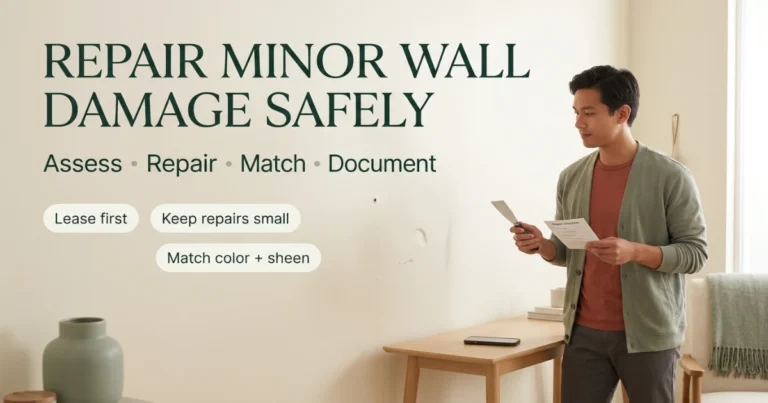
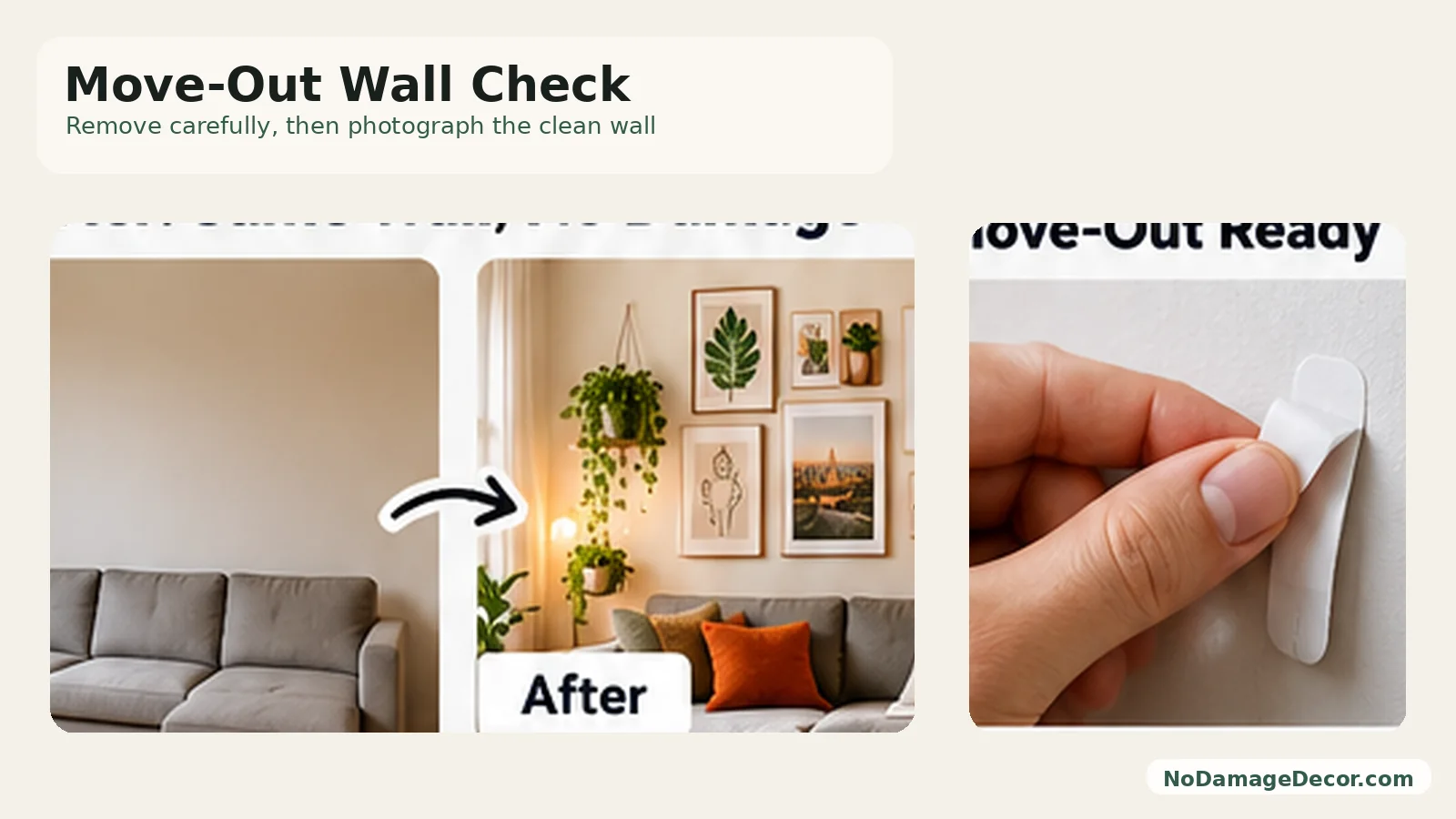
Correct removal is one of the biggest differences between a successful temporary setup and a repair job. For Command picture strips and hooks that use stretch-release adhesive, 3M instructs users to hold the base lightly and pull the tab straight down along the wall slowly. Do not pull the strip outward toward yourself.
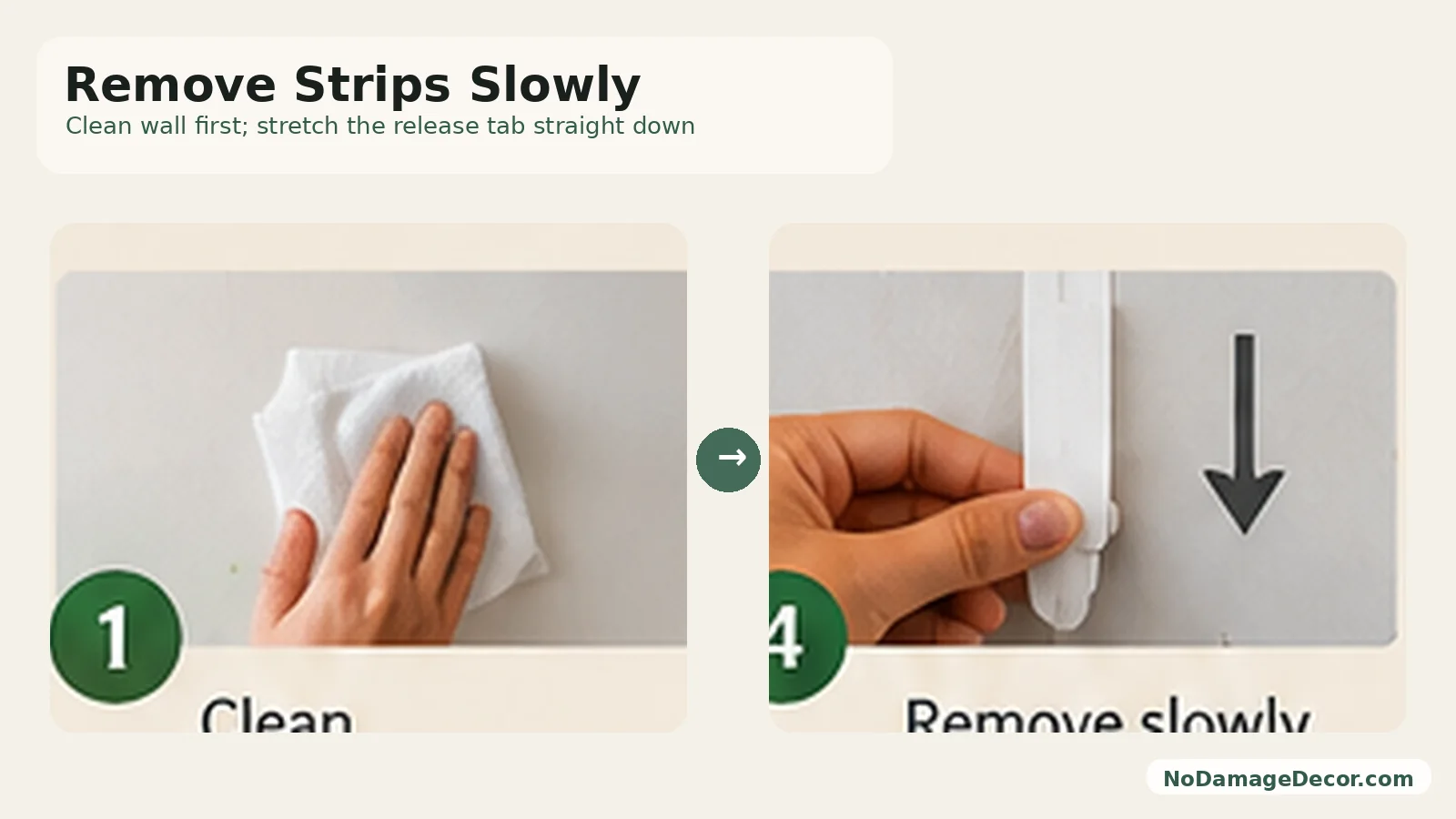
If a tab breaks, do not yank the mounted base off. Command’s current FAQ recommends following the product’s broken-tab instructions and notes that floss or string plus gentle heat may be used for some stuck bases. For a step-by-step removal guide, see remove Command strips without damage.
For wallpaper or decals, follow the exact brand’s removal method. Tempaper currently says to lift a corner and slowly peel away. Stop if the paint begins lifting, because continuing the same technique across an entire wall can enlarge a small finish problem.
Common No-Damage Wall Decor Mistakes
Calling every adhesive “damage-free”
Paint strength, wall texture, age, cleaning residue and removal technique all change the outcome.
Using one weight limit for every product
A 15 lb picture-strip rating does not apply to small hooks, decorating clips or shelves.
Hanging valuable items on temporary adhesive
Manufacturer warnings matter. Use freestanding or properly anchored solutions for valuables and injury-risk items.
Applying adhesive to fresh paint
Follow the exact product’s paint-cure guidance. Command and Tempaper currently publish different waiting periods for their own products.
Mounting above a bed
Do not ignore explicit manufacturer warnings simply because the object feels light.
Waiting until move-out to learn removal
Save the packaging, instructions and product name when you install temporary décor.
Sources & Renter-Safety Note
Technical claims in this update were checked against current manufacturer guidance. Product instructions can change, so the exact package or manufacturer page for the item you are using takes priority.
- Command — picture hanging strip installation and removal
- Command — surface, removal and broken-tab FAQs
- 3M — Small Wire Hook surface and load guidance
- Tempaper — recommended surfaces, paint cure and removal guidance
- RoomMates — peel-and-stick wallpaper surface guidance
Lease and security-deposit rules vary by state, city, property, lease and circumstances. Keep move-in photos and written landlord communication when an alteration is unclear.
FAQs About No Damage Wall Decor Ideas
What is the safest wall decor for renters?
The lowest-contact options are usually freestanding or leaning decor such as floor easels, furniture-based art and stable floor accessories. For wall-mounted decor, use a product whose surface and weight instructions match your wall and item.
Do Command strips damage apartment walls?
They are designed to remove cleanly when used on approved surfaces and removed correctly, but weak, old, uncured or damaged paint can still lift. Follow the exact product instructions and remove by stretching the tab straight down along the wall.
How long should I wait after painting before using Command products?
Current 3M guidance for many indoor Command products says to wait seven days after painting. Check the exact product package because instructions can vary.
Can I use Command strips on wallpaper?
Current Command instructions warn against using many indoor hooks and picture strips on wallpaper. Use another method unless the exact product specifically says otherwise.
Is peel-and-stick wallpaper safe for renters?
It can be a practical temporary finish on compatible walls. Tempaper currently recommends smooth walls in good condition with compatible cured paint, and RoomMates specifies smooth, flat, clean, dry painted surfaces. Test your actual wall before covering a large area.
How can I decorate without using adhesive at all?
Use leaning art, a floor easel, a freestanding mirror designed for floor use, floor lamps, bookcases, ladder shelves, plant stands, tension-based decor and furniture-mounted displays.
Can I hang heavy mirrors or shelves without nails?
Only use a no-drill system if the exact manufacturer supports the object, surface and full load. For heavy or injury-risk items, a freestanding product or properly anchored installation with landlord approval is usually the more responsible choice.
Use the Least Permanent Method That Still Safely Supports the Decor
No damage wall decor ideas are most reliable when the wall carries as little risk as possible. Start with freestanding or leaning décor, then use manufacturer-rated removable products for lightweight wall items on approved surfaces. Treat wallpaper, shelves, mirrors and planters as higher-commitment decisions because the covered area, load or injury risk is greater.
Do not rely on blanket “damage-free” claims. Match the product to the surface, wait for paint to cure, stay within the exact load limit, keep removal tabs accessible and follow the removal direction. That is a much stronger renter strategy than trying to make one adhesive product solve every decorating problem.
Plan the Whole Apartment With Reversible Decor in Mind
Once the walls are handled, use the broader checklist to prioritize the rest of the apartment without creating unnecessary move-out work.
See the First Apartment Decorating Checklist