Can You Reuse Command Strips? What Actually Needs Replacing
The short answer is no for the adhesive — but many other parts can be reused. Here’s what to replace, what to keep, and how to re-mount safely.
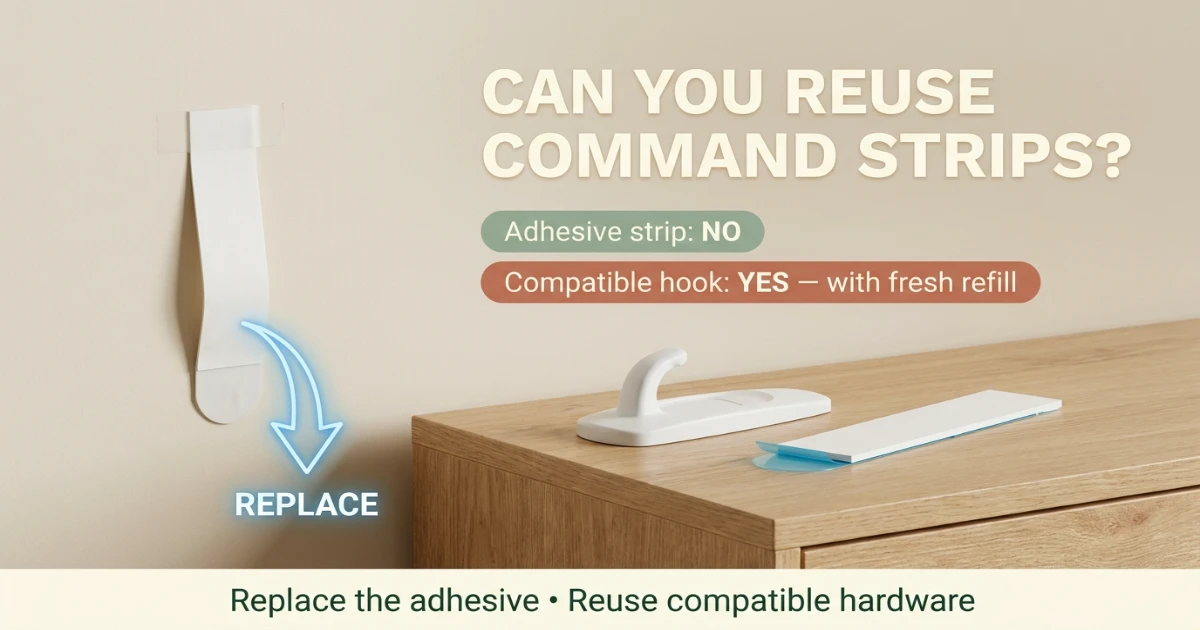
No—once a Command adhesive strip has been removed, do not reapply it. Command sells replacement strips specifically so compatible hooks and some mounting hardware can be moved and rehung with fresh adhesive. Reuse the hardware only when it is compatible, undamaged, and the correct fresh replacement strip is available. For picture-hanging products, use fresh strip pairs and follow the exact current instructions for the product.
At a Glance
Adhesive Strips
Do not reapply a removed adhesive strip. Use a fresh compatible replacement strip.
Hooks and Clips
Many compatible indoor hooks and mounting bases can be rehung with fresh Command replacement strips.
Why Reuse Fails
Stretch-release removal is designed to take the used strip off cleanly; the removed strip is not intended for another installation.
Safe Alternative
Buy replacement strips, clean the surface thoroughly, and apply fresh adhesive for a reliable hold.
Why Command Strips Are Single-Use
Command adhesive products are designed to hold on compatible surfaces when installed according to the product instructions and to release through a stretch-removal process. Once a strip has been removed, Command’s own replacement-strip system treats that adhesive component as spent: compatible hardware is rehung with a fresh strip rather than the removed one.
That distinction matters for renters. The hook or mounting base may still be perfectly usable, but the adhesive that was attached to the wall should not be pressed back into service. A fresh replacement strip gives you a clean installation with the correct liner, tab orientation, surface prep, pressure and wait time.
The Stretch-Release Mechanism Explained
Command’s stretch-release system works by pulling the removal tab slowly straight down along the wall so the strip elongates and releases. For Picture Hanging Strips, the current instructions say to peel the frame away first, never pull the strip outward, and stretch the tab slowly down the wall at least 15 inches (38 cm).
After that removal, use a new compatible strip for the next installation. Command replacement-strip products are specifically sold so compatible hooks can be moved and rehung with fresh adhesive.
For renters, this single-use limitation is actually a benefit when understood correctly. It means you can trust that a properly installed strip will hold until you deliberately remove it — and that removal, when done correctly, is designed to minimize wall damage. For renters, using the correct fresh replacement strip is the more reliable choice than trying to improvise with an already-removed adhesive.
What to Replace vs. What to Reuse
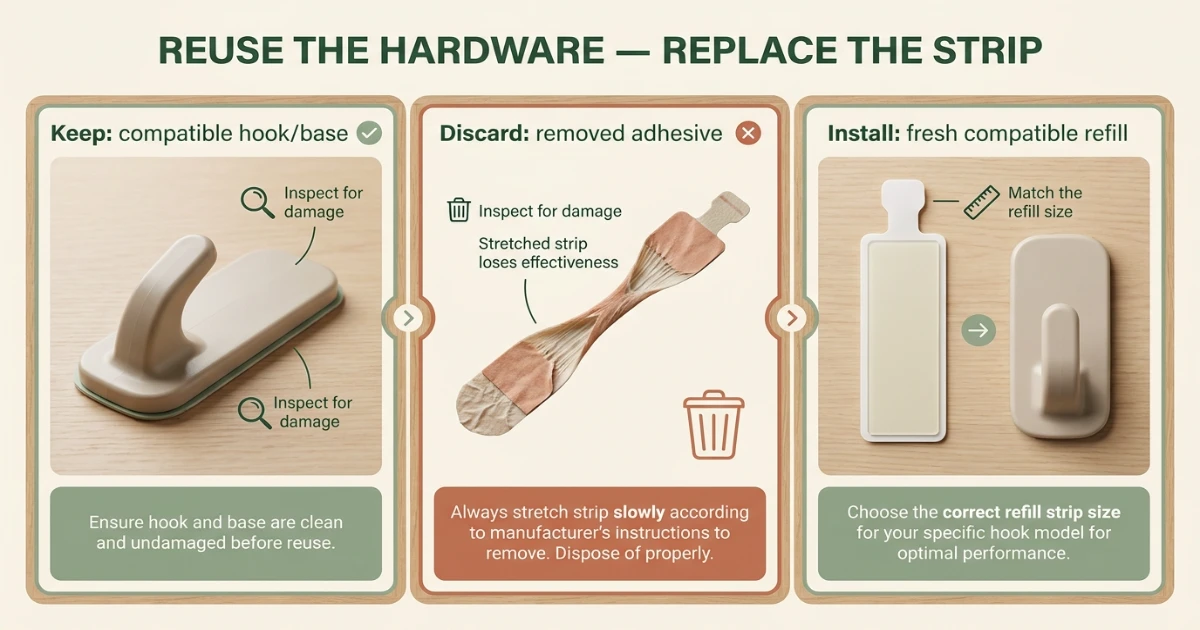
Many renters assume that removing a Command product means throwing the whole thing away. That is often not the case. The adhesive strips are the disposable component, while the attached hardware — the hook, clip, cord organizer, or mounting base — is typically reusable. Understanding this distinction can save money and reduce waste without compromising safety.
| Component | Replace or Reuse? | Notes for Renters |
|---|---|---|
| Adhesive strips (the part that touches the wall) | Always replace | Single-use. Never reapply after removal, even if the strip looks intact. |
| Plastic hook or clip | Usually reusable | Clean the mounting base and attach fresh strips for a new installation. |
| Mounting base or bracket | Usually reusable | Check for cracks, warping, or damage before reuse. Replace if compromised. |
| Picture hanging strips (interlocking pairs) | Use fresh pairs for a new installation | Do not reuse adhesive strips removed from the wall or frame. Follow the exact Picture Hanging Strip instructions. |
| Water-resistant replacement strips | Use fresh replacement strips | Use the exact water-resistant product and environmental instructions for the hook or accessory. |
Before reusing a hook or mounting base, inspect it for visible cracks, deformation, or damage and confirm that the replacement strip is intended for that hardware. If the hardware is damaged or the correct refill strip cannot be identified, replace the complete product rather than improvising.
What Happens When You Reuse Strips
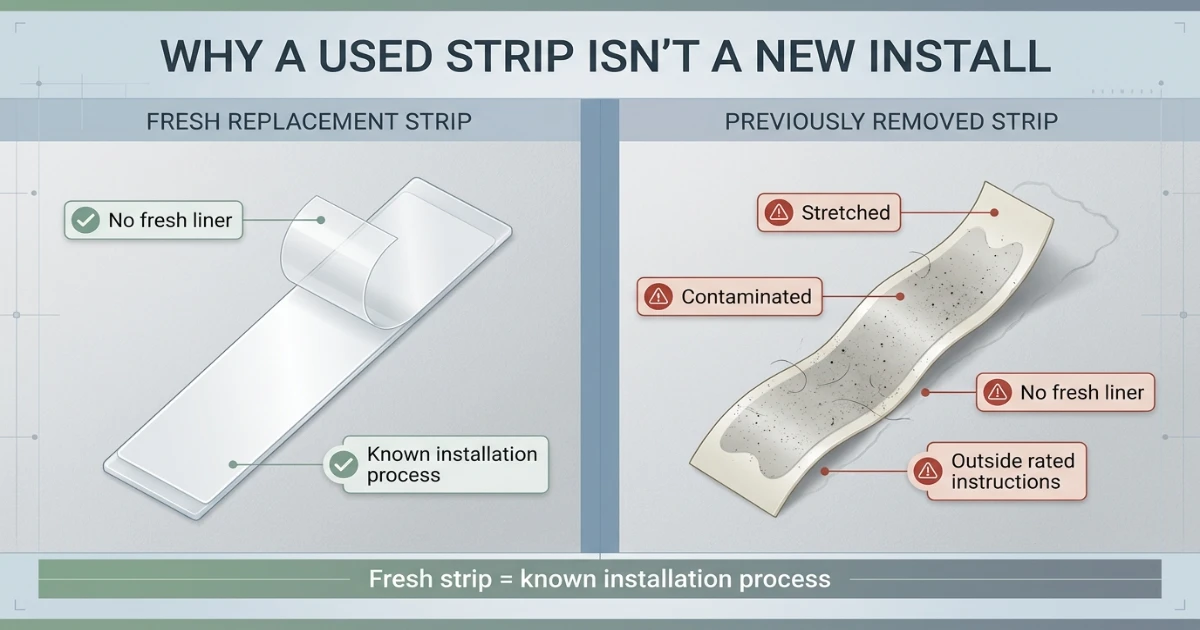
A removed Command strip is not the correct adhesive component for a new installation. It may be stretched, distorted, contaminated, or no longer have the liner and tab configuration required for the normal application process. Even if it still feels slightly tacky, do not treat that as proof that it can safely carry the original rated load.
Three Failures That Result From Reused Strips
1. Unreliable hold. The original product rating applies to a fresh strip installed according to the instructions, not to a removed strip pressed back onto the wall.
2. Incorrect application sequence. A used strip no longer gives you the normal clean liner, adhesive surface, tab orientation and pressure sequence the product was designed around.
3. Harder troubleshooting. If an improvised reapplication starts to lift or leaves residue, you are dealing with a setup that the manufacturer does not rate or instruct you to use.
How to Replace Strips Safely
Replacing Command strips correctly is straightforward, but the quality of the result depends almost entirely on preparation and patience. Rushing through the steps — especially surface cleaning and pressure application — is the most common reason replacement strips fail prematurely.
Step-by-Step Replacement Process
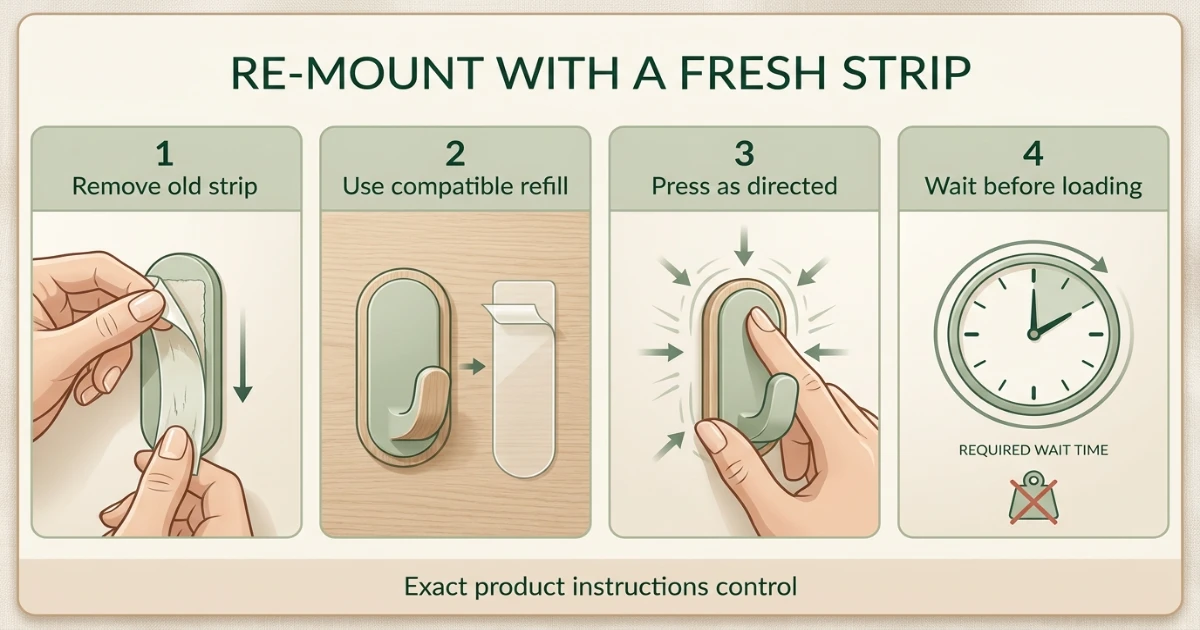
Step 1: Remove the old strip completely. Use the product’s stretch-release method and never pull the strip outward. If a hook or hanger strip breaks, Command’s FAQ recommends gently warming the base plate with a hair dryer and using dental floss to cut through the foam, then removing the remaining adhesive as directed.
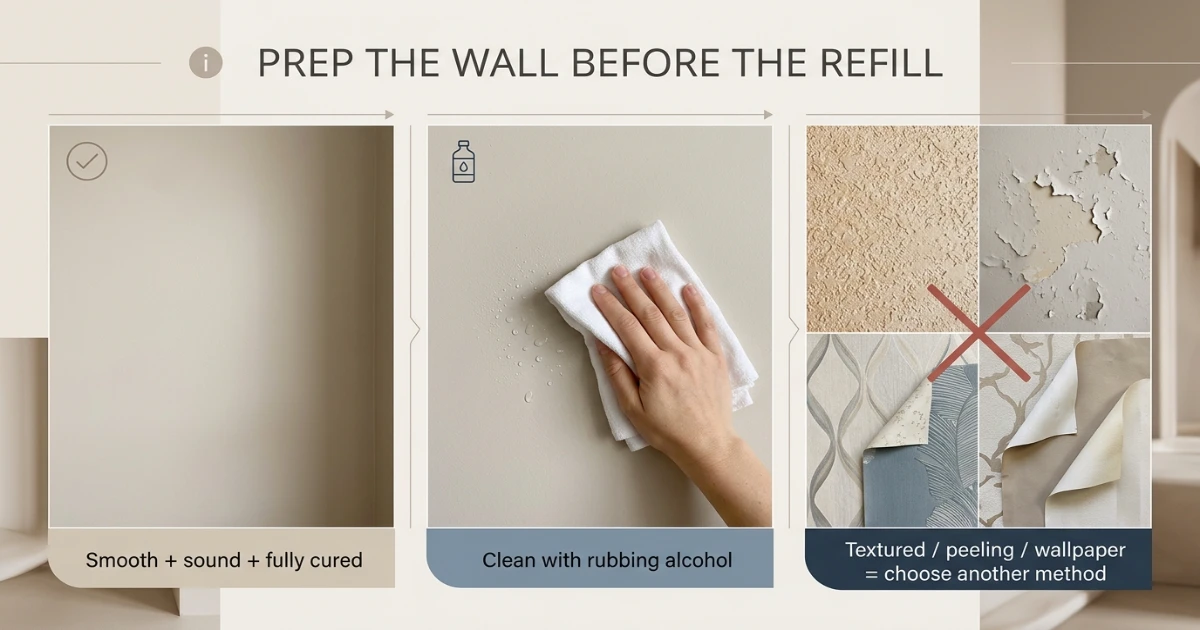
Step 2: Start with a clean compatible surface. Remove any leftover adhesive using the appropriate method first. Then wipe the mounting area with rubbing alcohol and let it dry. Command advises against household cleaners because they can leave residue that affects adhesion.
Step 3: Inspect the wall for damage. Look for any paint lifting, drywall paper exposure, or cracks. If the wall surface is no longer smooth and intact, adhesive mounting may not be appropriate. Consider a different method for that spot.
Step 4: Prepare the reusable hook or base. Remove the old strip completely, make sure the hardware is clean, dry and undamaged, and identify the exact compatible replacement strip before remounting.
Step 5: Apply the fresh replacement strip exactly as directed. Hook, clip and picture-hanging products use different application sequences, so follow the current instructions for the exact product rather than transferring steps from another Command item.
Step 6: Apply the specified pressure. Many current indoor Command hook and picture-hanging instructions use a 30-second firm press during installation. Follow the exact pressure step on your package.
Step 7: Wait before loading the adhesive. Current Command hook and Picture Hanging Strip instructions commonly use a 1-hour wait before use. If your exact product says something different, follow that package.
Step 8: Stay within the exact product limit. Confirm the rated load, required strip count, compatible surface and intended use. Do not add extra hooks or strips as a substitute for a product that is not rated for the item.
Surface Preparation for New Strips
The wall surface is the other half of the adhesive bond. Even a brand-new strip will fail if the surface is dirty, dusty, oily, or poorly cured. Proper preparation is especially important in a rental, where you cannot control the age or quality of the paint, and where surface damage during removal is a deposit risk.
| Surface Condition | Preparation Required | Expected Bond Quality |
|---|---|---|
| Smooth, fully cured painted drywall | Clean with rubbing alcohol; let dry | Compatible when the exact product instructions allow |
| Textured or rough wall | Do not use standard Command strips unless the exact product explicitly allows it | Current standard strip guidance excludes textured and rough surfaces |
| Freshly painted wall (under 7 days) | Wait at least 7 days before using standard Command picture-hanging products | Do not apply yet |
| Wall with old adhesive residue | Remove residue completely; clean surface | Reduced if residue remains |
| Wall with peeling or flaking paint | Do not apply adhesive strips | Very low — paint may separate from wall |
| Wallpaper | Do not use standard Command products | Current Command guidance excludes wallpaper |
For standard Command Picture Hanging Strips and picture hangers, Command’s current instructions say to wait at least 7 days after painting before use. That manufacturer wait period is the practical rule to follow for this article rather than trying to estimate paint cure from touch alone.
What to Look For When Buying Replacement Strips
When purchasing replacement strips, it is important to match the new strips to the specific Command product and the surface you will mount on. Not all Command strips are interchangeable, and using the wrong type can compromise both holding power and clean removal.
Key Selection Criteria for Replacement Strips
1. Match the product line. Command makes different strip types for different product families. Picture hanging strips, utility strips, and hook-specific strips are not interchangeable. Check the product packaging to identify the correct replacement type.
2. Verify the weight rating. Replacement strips should match or exceed the weight rating you need. Do not assume that all strips of a given size carry the same rating — ratings vary by product line and strip count.
3. Confirm surface compatibility. Standard replacement strips are for compatible smooth surfaces. Current Command guidance excludes wallpaper, textured walls, brick and rough surfaces for standard indoor strips; choose another method unless the exact product explicitly states otherwise.
4. Check for moisture resistance. For bathrooms, kitchens, or other humid areas, look for strips rated for moisture resistance. Standard strips may fail more quickly in high-humidity environments.
5. Buy enough for the full job. Replacement strips are often sold in multi-packs. Count how many strips you need before purchasing — including extras in case of installation mistakes or future re-mounting needs.
Before buying replacement strips, verify the exact Command product family, replacement-strip size, intended surface and current instructions. Product formulations and packaging can change.
When to Use a Different Mounting Method
Command strips are an excellent solution for many renter scenarios, but they are not the right answer for every wall or every object. Recognizing when to switch to a different method can save you from a fallen item, a damaged wall, or a security-deposit dispute.
Choose a Different Method When:
The wall is heavily textured or porous. Adhesive strips rely on maximum surface contact. Rough plaster, brick, unpainted drywall, and heavy texture reduce contact area and shorten effective lifespan. Mechanical fasteners or tension systems may work better.
The item is heavy, fragile, or valuable. Even when a product’s weight rating suggests it could work, adhesive mounting is inherently less predictable than a mechanical fastener. For irreplaceable art, large mirrors, or heavy shelving, consider alternatives that do not rely on adhesive alone.
The location is above a bed, crib, or seating area. Adhesive failure over a sleeping or seating area creates injury risk that is not worth the convenience. Use a more secure mounting method or relocate the item.
The wall has peeling paint or loose wallpaper. Adhesive strips bond to whatever is on the wall surface. If the paint or wallpaper is already failing, the strip may pull it away during removal — or fail to hold at all.
The room environment falls outside the product guidance. Standard indoor products and water-resistant/bathroom products can have different environmental instructions. Use the exact product intended for the room rather than assuming all replacement strips are interchangeable.
For guidance on adhesive-free mounting options, see our guide to hanging art without nails and our no-damage wall decor ideas.
Sources & Renter-Safety Note
This guide uses current 3M/Command guidance for replacement strips, hook re-hanging, picture-hanging application and removal, and broken-strip troubleshooting. Exact instructions vary by product, so the current package for the item in your hand takes priority.
- Command — Small, Medium and Large Replacement Strips
- 3M — Small Replacement Strips
- Command — How to Use Picture Hanging Strips
- Command — FAQ: Broken Strip Removal & Surface Cleaning
Lease rules and security-deposit standards vary by location and property. Keep move-in/move-out documentation and check your lease before changing mounting methods.
Renter-Safety Verdict
Command adhesive strips are designed to be single-use. Attempting to reuse them is a false economy — the money saved is minimal compared with the risk of a fallen item, a damaged wall, or a deposit deduction. The good news is that most Command hooks, clips, and mounting bases can be reused; only the adhesive strips need to be replaced.
When you re-mount with fresh strips, follow the exact product sequence: use a compatible smooth surface, clean it with rubbing alcohol when instructed, apply the specified pressure, observe the required wait time, and stay within the exact product limit. If the wall is textured, rough, wallpapered, peeling, freshly painted or otherwise excluded by the instructions, choose another mounting method.
For renters, the principle is simple: new strips every time, clean surfaces every time, and when in doubt, use a more secure mounting method. This approach protects your decor, your walls, and your security deposit.
Know the Weight Limits Before You Re-Mount
Fresh strips are only part of the equation. Make sure you are using enough strips — and the right strips — for every item you hang. This guide covers rated limits, strip counts, and how to choose safely for your walls.
Command Strips Weight Limit GuideFrequently Asked Questions
Can I reuse a Command strip if it still looks sticky?
No. A removed strip is not intended for another installation. Command sells replacement strips so compatible hooks and hardware can be rehung with fresh adhesive. Do not treat leftover tackiness as a substitute for the rated performance of a fresh strip.
Can I reuse the plastic hook from a Command strip?
Many compatible Command indoor hooks can be rehung with fresh Command replacement strips; current replacement-strip product pages explicitly advertise re-hanging hooks. Inspect the hardware and use the exact compatible replacement strip.
Can I use a different brand of strips with my Command hook?
Use the replacement strip specified for the Command hook or accessory. Command’s own replacement strips are designed and labeled for compatible Command hardware; a different brand is outside that tested product system.
Can I reuse picture hanging strips on both sides?
For a new installation after the adhesive strips have been removed from the wall or frame, use fresh Picture Hanging Strip pairs. The exact current Picture Hanging Strip instructions should control the placement, pair count, weight and frame-size limits.
What happens if I try to reuse a Command strip and it falls?
A reused strip may fail immediately or days later. The item can fall and break, and the failed strip may pull paint or leave adhesive residue during cleanup. If you have already tried reusing a strip and it has fallen, remove the spent strip carefully, clean the surface, inspect for wall damage, and apply fresh strips before re-mounting anything.
How many times can I reuse a Command hook?
Command replacement-strip pages support re-hanging compatible hooks, but they do not publish a universal maximum number of reuse cycles. Keep reusing the hardware only while it remains undamaged and the exact compatible fresh replacement strip is available.
Will reusing a Command strip damage my apartment wall?
A reapplied used strip is outside the manufacturer’s normal installation system, so do not rely on it for rated performance. If you already reapplied one, remove it using the appropriate stretch-release guidance and avoid pulling or prying outward.